Transfer of the relics of the great martyr Theodore Stratilat
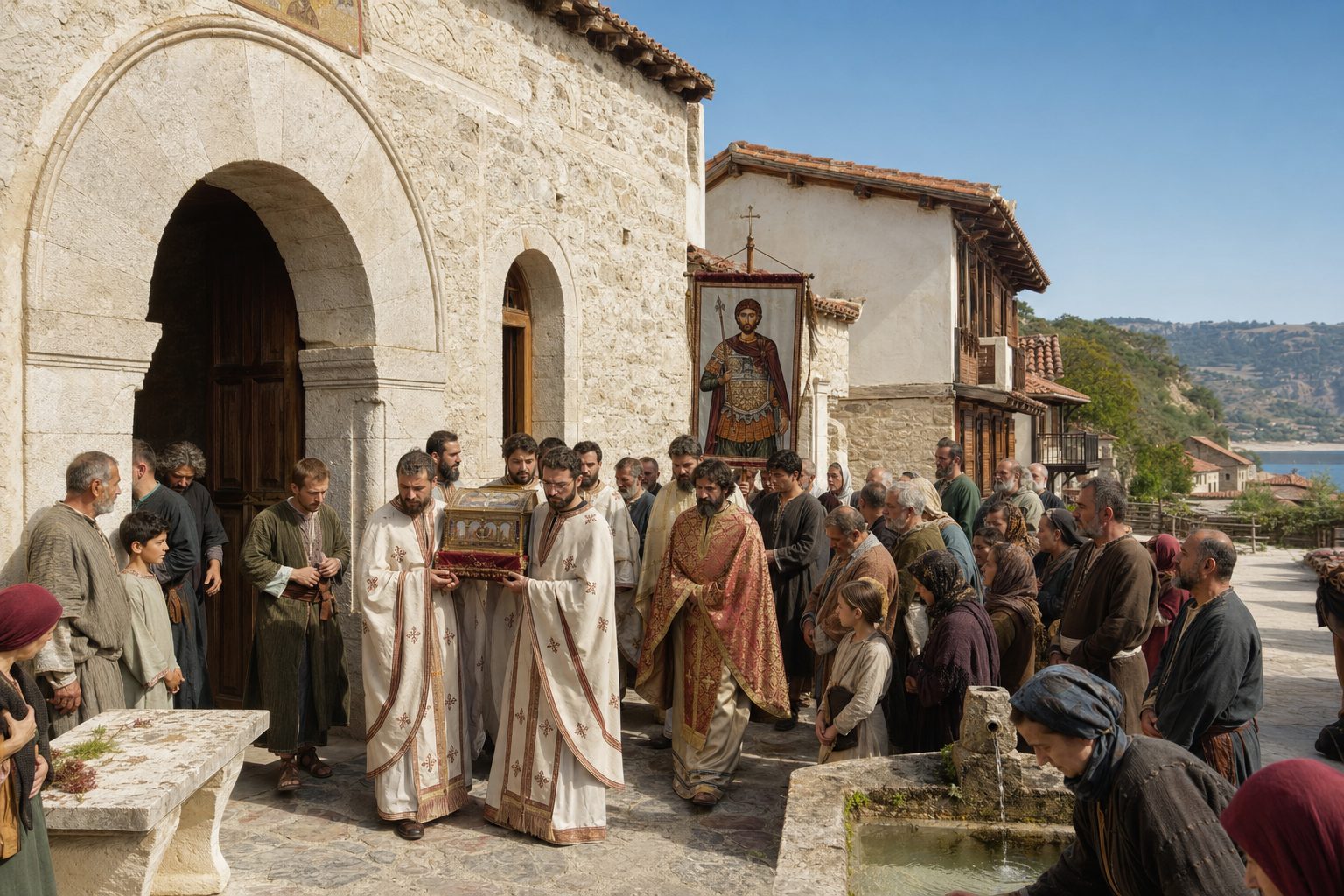
The holy great martyr Theodore suffered for the name of Christ under the wicked Roman emperor Licinius [Licinius ruled the eastern half of the Roman Empire from 307 to 324.
Feodorus dates to 319 C.E.), in the city of Heraclea, where the saint was a voivode; the time of his martyrdom was the eighth of February; now it is celebrated the transfer of his honourable relics from the city of Heraclea to his native city of Evhaita
[The city of Euchaita was in the northern part of Asia Minor, near Heraclea; now the town of Marsivan.] according to his decree, for his servant Uaru, who had watched the sufferings of the martyr and recorded them, St. Theodore gave this will:
"My body is buried in Evhaitis, in the estate of my parents". All who wish to know more about this saint can read the detailed description of his sufferings, placed under the eighth day of the month of February.
This miracle is attested by Anastasius Sinait [Anastasius Sinait - Patriarch of Antioch; ruled the patriarchal cathedral from 561 to 572, then from 596 to 601 - see his life under the 20th of April.] and John of Damascus [John of Damascus - the most famous church fable writer and theologian of the VIII century.
He wrote many highly impressive church canticles; he also wrote canons for Easter, Christmas, the Epiphany, and many canticles for the days of the saints.
The most important of these is the "Source of Knowledge", which consists of three parts: 1) "Dialectics"; 2) "Books on Heresies" and 3) "Exact Exposition of the Orthodox Faith".
John of Damascus tells of a miracle from the icon of the great martyr Theodore Stratilat.
[Damascus is the oldest Syrian city mentioned in the Bible in the history of Abraham (Gen. 14:15) ] was located northeast of Palestine, in a beautiful and fertile plain at the eastern foot of Anti-Lebanon.
In the history of the Christian church, Damascus is notable as the place of Saul's miraculous conversion to Christ (Acts 9:1-22).
It was annexed to the Turkish Empire.] is a place called Karsat; here stood a church, built in honor of the holy great martyr Feodor Stratilat.
When the Saracens took possession of this place and settled here, many of them entered this church and defiled it in every way; for example, they drove their cattle into the church, entered that church with their wives and children and committed abominable sinful works of the flesh here.
On one of the church's walls was a painted image of the holy great martyr Feodor.
One day, when many Saracens were gathered in this church and were talking among themselves, one of them, pointing at a bow and arrow, shot at the image of the saint; the arrow went into the right shoulder of the saint, and immediately the image gushed out blood as from a living person.
Seeing such a great miracle, the Saracens were very surprised, but they did not leave the church, but continued to live in it and to commit unclean deeds here, and, according to their custom.
In all, twenty Saracens lived in this church, each with a wife and children; all of them soon after the miraculous event died, being suddenly struck with a bitter death; those of the Saracens who lived outside the church were healthy and unharmed at that time.
Anastasius Sinaiticus says that he saw this image of the saint himself and that the image was marked by blood that had come out of the ulcer.
This miracle was done by the Lord to frighten the wicked Saracens, and to remind us, the faithful, that we must revere the holy icons, for in them is and through them works the marvelous grace of our God.
The true warrior, the true warrior, the heavenly King, the great warrior, the great warrior, the great warrior, the great warrior, the great warrior, the great warrior, the great warrior, the great warrior, the great warrior.
With the courage of the soul in the faith, and the words of God, like a spear in the hand in the ground, the enemy has defeated you, the martyrs of the great Theodore: with them to Christ God praying do not cease for all of us.
The fourth voice, the throbbing.
Tropeus, voice 4: A true warrior, a true passionate warrior, a celestial king, a warrior who was defeated by the great theologian Theodorus. With the weapons of faith he fought wisely, and overcame legions of demons, and became a victor.
Condak, second voice.
2 Lichinius ruled the eastern half of the Roman Empire from 307 to 324 - The martyrdom of Feodorus refers to 319 A.D. Gerachia was located in the northern part of the province of Malesia, not far from the northern part of Malesia; 4 A. Gerachia was located in the northern part of Malesia, not far from Malesia.
5 Anastasius Sinait - Patriarch of Antioch; ruled the patriarchal cathedral from 561 to 572, then from 596 to 601 - See his life under the 20th of April. 6 John Damascene - the most famous church fable writer and theologian of the VIII century. He wrote many highly impressive church hymns; he has canons for Easter, Christmas, the Epiphany and many hymns for the days of memory of the saints.
7 Damascus is an ancient Syrian city mentioned in the Bible in the story of Abraham (Gen. 14:15); it was located to the north-east of Palestine, in a beautiful and fertile plain at the eastern foot of Anti-Lebanon.