The Life of Blessed Jerome
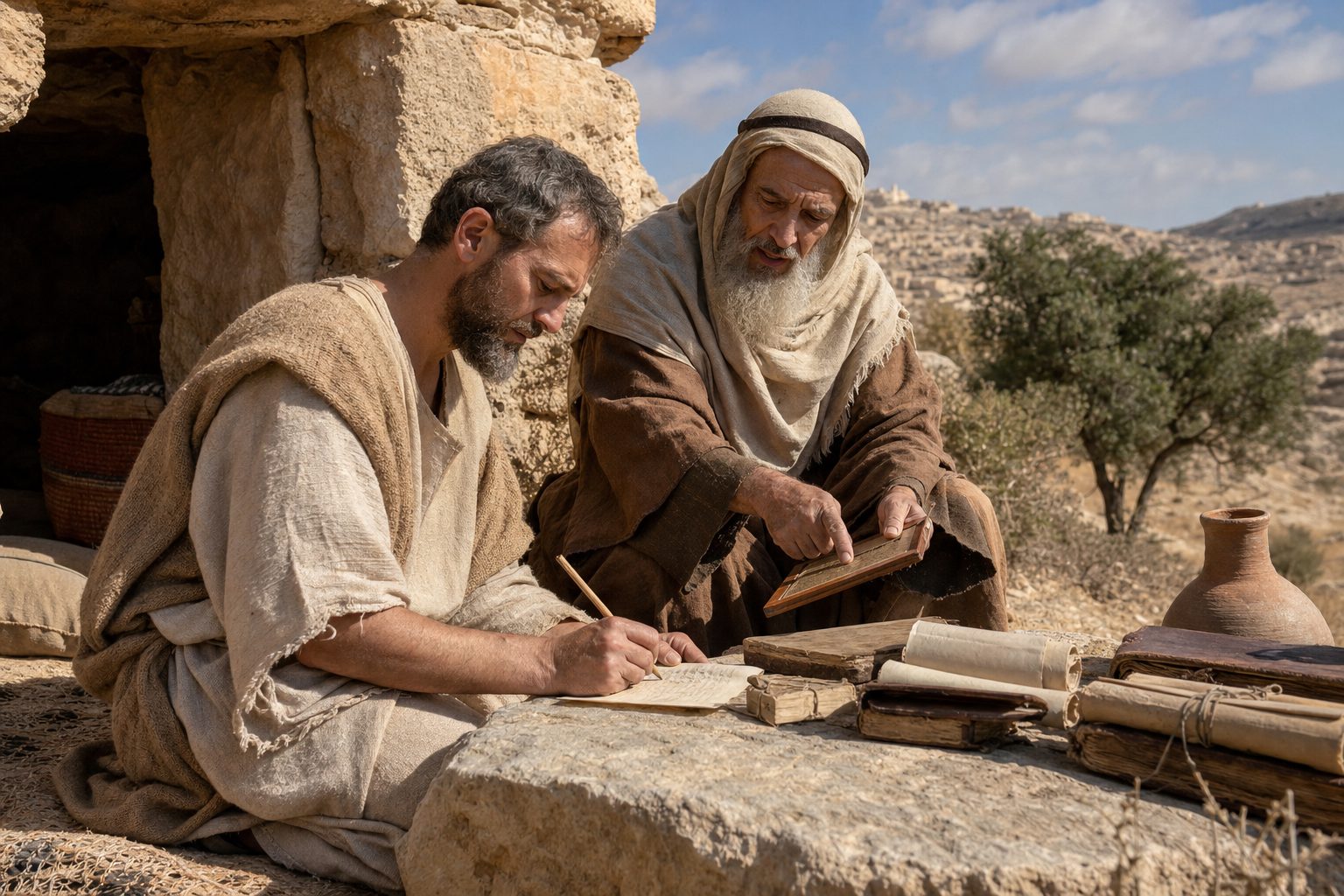
St. Jerome's birthplace was the small town of Strydon, on the borders of Dalmatia and Pannonia. The exact date of his birth is unknown.
He was probably born in the year of his father, Eusebius, and his birthplace is unknown, but it is probable that he was born in the year of his father, Eusebius.
The wealth of the parents of the blessed Jerome is indicated by the fact that he was able to make long journeys through Europe and Syria, having with him a library of selected writers: all this, of course, required considerable financial resources.]; they were Christians and gave their eldest son a strictly Christian upbringing.
"I have been nourished", said the blessed Jerome, "with the catholic milk from my cradle, and I was all the more devoted to the church, that I was never a heretic". Jerome received his primary education at home, and his teacher, despite his harsh nature, managed to instill in the talented pupil a love of science.
According to the custom of the time, logic and, as the main subjects, grammar and rhetoric were included in the course of teaching; blessed Jerome, besides, got acquainted with the teachings of some philosophers, but especially much time he devoted to the study of eloquence; he visited the courts to listen to the famous court orators.
His stay in the capital of the world, amid temptations and temptations, left a sad trace in Jerome's soul: he himself admitted that "during the slippery wanderings of his youth" he had led an unclean life in Rome, a circumstance that later cost him many tears and bitter regrets.
He did not break off prayerful fellowship with his fellow believers; besides, on Sundays he, together with Pammachus and other companions, was accustomed to visit the tombs of the martyrs in the vicinity of Rome; on these visits Jerome had to descend into the dark catacombs [Catacombs (catacumbae) - underground passageways and caves arranged in an irregular network: catacombs are known near Rome, in Naples, Syracuse, and on the island of Malta.
The catacombs around Rome are so vast that if they could be drawn in a straight line, they would be the length of the Italian peninsula.
The catacombs also served as a secret place of worship and burial for the dead for the first centuries: it is assumed that for this purpose the Christians used the old abandoned underground passages formed during the mining of pottery clay: the Christians only continued and expanded them.
Here in Rome, before he had finished his education, Jerome decided to change his life and start a new one, one that was pure and good.
Probably he did not hesitate to confirm his intention of baptism [At that time it was customary to postpone baptism - in most cases out of a desire to atone for the sins of a previous life by baptism and partly out of fear of breaking the vows of baptism in the early years, when the will was not yet strong and one was susceptible to sinful temptations.]; the exact time of the baptism of Blessed Jerome is unknown, but with a large proportion of approximation to the truth it is permissible
The suggestion is that he was baptized when he was in his early 20's and that the sacrament was administered to him by either Pope Liberius or one of his clergy.
On leaving Rome, Blessed Jerome undertook a long journey through Gaul, accompanied by Bonoz, his schoolmate and younger brother. During this journey, Jerome, in his own words, "on the semi-barbarian banks of the Rhine first felt the desire to serve God", that is, he began to awaken the desire to become a monk with his vows of virginity and poverty.
In about 372, Blessed Hieronymus returned to Strydon from his travels in Gaul, his parents having died, and he had to care for the inherited estate, his sister and younger brother Pavlichian, who was twenty years younger than he.
These concerns probably enabled Jerome to carry out his intention to withdraw from the world, and he only partially satisfied his desire for monasticism by living occasionally in Aquileia, where a small semi-monastic circle of persons close to each other and to blessed Jerome was formed.
And it came to pass, when he was come to Jerusalem, and to the hermits of Syria and Egypt, that he went forth into the east, and went with them unto Antioch, which was his native city.
They traveled through Thrace, Bithynia, Pontus, Galatia, Cappadocia, and Cilicia. The hardships of the long journey, combined with ascetic feats, undermined the strength of the pious pilgrims.
Jerome's illness was aggravated by grief, and it lasted for a long time, probably until the spring of 374.
He was also known as the "Father of Prophecy" and "the Master of Prophecy".
Thus, in contrast with the emphasis of the Arians, who, according to their teaching about the Son of God as a created being, acknowledged the all-human nature of Christ, Apollinarius destroyed the human personality in the Lord Jesus.
From a psychological standpoint, he found the teaching of the Nicene Creed that perfect divinity and perfect humanity were united in Christ to be incredible: he reasoned that two entities, with all their properties preserved, could never be united into one.
The idea of the God-man was also unthinkable to him from the dogmatic point of view: sin is connected with the whole of humanity, but if we think of sin in Christ, even as an opportunity, the work of redemption for him becomes impossible.
Therefore, following the Greek philosopher Plato in dividing the nature of man into body, animal or vital soul (pykn) and spiritual soul, spirit (noys), Apollinarius believed that Christ, having taken upon Himself the human body and soul, did not take upon Himself the distinctive part of the human being - the human spirit, since the latter necessarily presupposes freedom, and with it the inclination to sin, the human spirit, according to Apollinarius, in Christ replaced the human spirit.
The divine Logos, ruling over all the evil impulses of the animal soul.
Apollinarius died in 390. Apollinarius' heresy was condemned by the Council of Alexandria in 362. In 375, when Apollinarius separated from the church and began to form his own sect, he was condemned by the Council of Rome; the last condemnation was repeated by the Second Ecumenical Council.] He did not leave behind the intention of retreating into the desert, where he was especially attracted by the death of his loved ones, especially since Iliodorus and Nicaea did not want to continue the journey.
In 374, Hieronymos decided to settle in the "Syrian Fevaida" - the Chalcedonian Desert (to the East of Syria).
Here he stayed for almost five years, living probably in some monastery and occasionally leaving it for desert seclusion, approving the dormitory and advising him to others, blessed Jerome, as his "Life of Paul the Hermit" shows, at the same time had a special respect, bordering on reverence, for those pilgrims who, settling alone in remote places of the desert, found refuge in mountain caves, sometimes for several years they did not
They saw a human face, and only wild beasts and scorpions disturbed their privacy.
In this work, Blessed Jerome mentions, among other things, two hermits he saw in the Chalcedon Desert: one of them for 30 years ate only barley bread and drank dirty water; the only food of the other was dates, which he was thrown to the bottom of the old pond where he lived every day in the amount of 5 pieces.
Deadening his flesh with his prayer, harsh feats of fasting, privations, and physical labor, Blessed Jerome in desert solitude devoted himself to the study of the Holy Scriptures, using the necessary books from his own library and the library of friends living nearby in Antioch, mainly Evagrius.
At the same time, under the guidance of a converted Jew, he began to study the Hebrew language, in which the books of the Holy Scriptures of the Old Testament were written, the last activity for the blessed Jerome also served as a humiliating means: this goal was fully matched by the humiliation of learning the alphabet and the unmusicalism of Hebrew words, not pleasant for the blessed Jerome, who formed his syllable on the study of the best representatives
It's a classic.
To this period of the life of blessed Jerome probably belongs the following remarkable dream, which he describes thus: "Poor man", he says, "I fasted just before I intended to read Cicero; after many vigils lasting all night, after tears gushed from the very heart by the memory of my past sins, I usually married Plautus.
And when I came to myself, and began to read the prophets, their harsh words made me afraid, and seeing that I could not see the light with my blind eyes, I thought that it was not my eyes' fault, but the sun's. And when that ancient serpent tempted me in this manner, about the middle of the fast, my weary body was seized with the fever of the seed that was in me, and without any relief it so fed my wretched members that hardly the skin held on to my bones.
Meanwhile preparations were being made for my burial, and the heat of my soul was hardly warming in the slight warmth of my breast, and my whole body was cold; and suddenly I was amazed in spirit before the judgment seat of the Divine Judgment, where there was such a stream of light and such a brightness of glory from angelic spectators that I could not raise my eyes to the ground.
"You are a liar", answered the Inquirer, "you are a Cizerean, not a Christian; for where your treasure is, there your heart is also". "I was instantly dumb, and under the blows (for He had ordered my scourging) I was even more tormented by the fire of my conscience, reflecting on the well-known verse: 'Who will confess you in hell?'
Then those who stood by me fell down on their knees before the Judge, begging him to forgive my youth and to grant me the opportunity to repent of my error, and to punish me afterwards if I ever read pagan literature.
I was released after this oath, I returned to the higher realms of the air, and to the surprise of all, I opened my eyes, so full of tears that my fear convinced even unbelievers, and indeed it was not a dream, nor a mere dream, by which we are often deceived. This tribunal before which I stood, this terrible tribunal which I feared, is my witness; may I never again be brought before it.
I confess that my shoulders have turned gray from the beatings, that when I awoke I felt the most blows, and that from now on I read the divine books with more zeal than I had read the human books".
In this connection the letter of the blessed Jerome to the presbyter Eleodorus is particularly well known; in these fiery words he persuades his friend to renounce the world: "Down with supplications, away with flatteries! thou hast disregarded me when I pleaded with thee; perhaps thou wilt listen to me when I rebuke thee. O frozen soldier, what doest thou in thy treacherous house? behold, a trumpet soundeth from heaven.
Behold, the prince comes down from the clouds armed to conquer the world, and behold, the two-edged sword from his mouth destroys all obstacles.
Even if your little nephew were hanging on your neck, even if your mother were showing you the breasts with which she fed you, even if your father was lying on the threshold, walk over his body with dry eyes and run under the banner of the cross.
In Antioch in the early sixties of the fourth century, two bishops, Meletius and Paulinus, appeared at the same time, elected in 358 with the consent of the Orthodox and Arians [Arius - a heretic (died 386), who blasphemously asserted that our Lord Jesus Christ, the Son of God, is not God, the Father, but a created Being, and therefore eternal, though the most perfect of all created beings.
This heresy, known in the history of the Christian church as the Arian heresy, was condemned at the first Ecumenical Council (325) in Nicaea, whose fathers set forth the Orthodox doctrine of the oneness of the Son of God with God the Father: "We believe... in one Lord Jesus Christ, the only begotten Son of God, born of the Father, i.e.
of the essence of the Father, God from God, Light from Light, true God from true God, begotten, uncreated, one and only Father, through whom (the Son) all things were made, both in heaven and on earth"; the very heresy was condemned by the council fathers.
But the Nicene Creed did not put an end to the ecclesiastical confusion caused by Arianism: the Arian bishops, who were present at the council in considerable numbers, secured the conciliar creed with their signatures solely out of fear of the state power, which shared the beliefs of the Orthodox members of the council; having succeeded, soon after the end of the council, in attracting the state power to their side, the Arian leaders, with its support, entered into the
After a fierce struggle with the defenders of the right faith, in the middle of the 4th century they won almost complete external victory over their opponents, united under the sacred chorus of the Nicene Creed.] , as they both considered him their supporter, Meletius in fact justified the hopes of the Orthodox, declaring openly that he contains the teaching about the Son of God, which was set forth by the fathers of the 1st Ecumenical Council [See.
But since Meletius was not elected without the assistance of the Arians, the Orthodox zealots, lovingly honoring the memory of the great hierarch of the Church of Antioch, Eustathius, who had been unjustly deposed by the conspiracy of the Arians, separated from Meletius under the leadership of the presbyter Paulinus, who in 362 was elevated to the rank of bishop.
The situation was further complicated when, in 376, a third bishop, an apollinarian, was appointed to the same Antioch [i.e., one who shared the heretical error of Apollinarius of Laodicea, see above, p. 451].
While Pauline adopted a Western formula for the doctrine of the Trinity, namely, "one isposthys [where the word was understood in the sense of the essence - the person] in three Persons", Meletius, following the usage of the East, recognized "one isposthys" [i.e., the person] and "three isposthys" [i.e., the person].
In essence, the proponents of both formulas understood the same thing, only expressing the same thought in different words ["Like the West, so do we", says St. Gregory the Theologian (see below) - piously declare that there is one entity and three hypostases, but since the scarcity of their alphabet does not give a separate expression for the usia and hypostases, they are forced to introduce the word prosopon (face), so as not to seem to recognize the tri-essence.
Can anything be more ridiculous or pathetic than to make it the object of controversy?"] These disputes, provoked in Antioch by the Melite schism and the Arian unrest, spread to the neighbouring Chalcedon desert, where blessed Hieronymos was martyred.
In a letter to Pope Damasus [Damas was bishop of Rome 366-384], he complained of the violation of desert solitude caused by these reasons: "The tireless enemy has followed me into the desert, so that now in solitary life I endure a struggle even worse than before settling in the desert.
On the other hand, the church at Antioch, divided into three parties [i.e., the supporters of the bishops Meletius, Paulinus, and Vitalius], is seeking to take me in".
In a letter to the presbyter Mark, two years after the letters to Damascus, the blessed father, by the way, says: "Why do they call me a heretic when I agree with the West and Egypt? I am not conceded a single corner in the desert. They ask me daily about my faith, as if I were born again without faith. I confess as they wish - they do not like it; I sign - they do not believe me. They only want to get rid of me. I am ready to leave".
In Antioch, blessed Jerome joined the community of Paulinus; the latter ordained him as presbyter. In the period described, the stay in Antioch could not have been pleasant for the blessed father, who was seeking peace.
St. Gregory the Theologian - the great father of the church and a universal teacher - was born about 329 in Arianza (a little south of Nazianz, a small town in Cappadocia).
Gregory received the papal chaplaincy in Caesarea, where he met for the first time with Basil the Great.
St. Gregory's best memories; here he befriended Basil the Great, and the two friends "knew only two ways - to school and the Christian church"; here he met the future emperor Julian, who later became notorious for his apostasy from Christianity.
In 359, on the day of Christ's birth, Gregory was unexpectedly consecrated as a presbyter by his father, Gregory the Elder, e.g. Nazianza. When the father of Gregory the Godfather simply signed the half-Arian symbol and thereby stirred up the Orthodox flock against himself, St. Gregory reconciled it with the bishop.
St. Gregory, however, remained with his elderly father as his vicar and assistant until his death, which followed in 373 or early 374. Soon after, St. Gregory's mother, Nonna, died; his brother and sister had died earlier.
In May 381, when the Second Ecumenical Council was convened by the will of Emperor Feodosius, St. Gregory was elected to the vacant chair of the Constantinople bishopric; the fathers of the council approved this election.
Soon the cathedral's chairman, Meletius of Antioch, died, and his place was taken by the newly elected bishop of the capital, St. Gregory. The disagreement between him and the cathedral fathers - mainly over the measures to stop the Melitian schism in Antioch - forced St. Gregory to withdraw to his homeland, where he spent time in seclusion, engaged in literary works; he died here in 389.
St. Gregory left a considerable number of works: 45 words, 243 letters and a collection of poems. The words and some letters of St. Gregory had a great influence on the clarification of the Orthodox teaching about the Trinity and the Face of the Lord Jesus Christ.]
Here in Constantinople, the blessed Jerome met the Christian theologian-philosopher Gregory of Nyssa, who read to him his newly written work against the heretic Eunomius, who had sinned against the Orthodox doctrine of the Holy Trinity.
At the end of 381, Blessed Hieronymos left the hospitable Constantinople and went to Rome, prompted, as he put it, by "church necessity": one must think that Blessed Hieronymos was summoned to Rome by Pope Damasus to a council on the affairs of the ill-fated Melite schism, which did not cease in the Antioch church and after the death of Meletius.
The Second Ecumenical Council in Constantinople [in 381 under Emperor Theodosius the Great] elected Flavian in place of Meletius on his death; the pope, with the western bishops, supported Paulinus, who was the former bishop of Antioch and in the days of Meletius.
Therefore, when the council came to the question of his successor after the death of Meletius, the fathers of the council chose not Paulinus, who was supported by the West, but the presbyter of the Antioch church, Flavian, for they rightly said that in the affairs of the Eastern Church the Lord should be the East, and not the West.] between the Eastern and the Western Church, and was the cause of the council called by Damasus.
Epiphanius, the son of a poor Jewish farmer in the Eleftheriopolis district of Palestine, was adopted as a ten-year-old orphan by his father's successor, the Jewish jurist Trifon.
Epiphanius fought against the archons, made a journey to the East to convert the fire-worshippers-Persians. At the direction of the above he was elected as an elder of sixty years to the bishop of the city of Salamis - the metropolis of the whole island of Cyprus.
St. Epiphanius is famous for his miracles and prophecies, and for his writings, including Ancorat (The Anchor) and Panarium (The Home Pharmacy). Ancorat expounds the doctrine of the oneness of the Divine Persons, the incarnation of Christ, the resurrection of the dead, eternal life and judgment, refuting various heretical objections.
The Panarium contains the history and refutation of the 20 heresies that preceded the birth of Christ and the 80 times of Christianity. For the history of heresies, these writings of Saint Epiphanius will always have the significance of one of the most important primary sources.] with which he met in Constantinople, where they stopped on their way to Rome.
The fathers of the council entrusted to the blessed Jerome, among other things, a confession of faith directed against the heretical error of Apollinarius. In general, the position of the blessed Jerome under Pope Damasus, especially at the beginning, was very influential.
In the early years of his stay in Rome, Blessed Hieronymos was widely respected and known for his ascetic lifestyle, scholarship and eloquence: it is enough to say that the blessed father was openly called the successor of Pope Damasus at the cathedral of the Roman Church.
Paul's insistence that Christian perfection was not possible without complete renunciation of the world and the flesh alienated not only the Gentiles but also many Christians, and some vicious members of society took advantage of this circumstance to accuse him of hypocrisy by spreading slander and accusations.
Many were also puzzled by Blessed Jerome's deep respect for Origen [a famous teacher of the Alexandrian Church, a marvel of his age in intellect and learning.
Many of the most remarkable of the Church Fathers had a deep respect for Origen's theological works and merits; but he was later condemned as a heretic at two local councils in Alexandria and at the Council of Constantinople in 543.
While not expressing his unorthodox views as truths that cannot be disproved, Origen nevertheless misunderstood many of the truths of the Christian church's creed, which is why some questioned its firmness in the main Christian dogmas.
Developing the unorthodox doctrine of the pre-existence of souls, he mistakenly thought of Christ, believing that God created a certain number of equal spiritual beings capable of understanding the Godhead and being like Him; one of these created spirits with such a burning love strived for the Godhead that he became inseparably united with the Divine Word or became His creature carrier; this, in Origen's opinion, is the human soul through which
God the Word could have become flesh on earth, since the direct incarnation of the Godhead, in his erroneous view, is unthinkable.
Holding a heretical view of the incarnation of God the Word and the creation of the world and man, Origen understood the death of Christ in an unorthodox sense, presenting it as something repeated spiritually in the spiritual world and having an effect there on the liberation of angels and attributing too much of the work of salvation to the action of ordinary forces with which our nature is endowed.
But in any case, Origen's service to the Church is more significant and covers up his errors.
In his schools he educated many remarkable fathers and teachers of the Church, some of whom owe to him their conversion from paganism to the Christian faith, with which he wanted to harmonize knowledge and philosophy.
In the persecutions of Decius, Origen was honored as a courageous confessor of Christ, and died at the age of seventy in Tyre in 254.] Such hostility, that even his obvious merits were blamed on the blessed Jerome [So, for example, the necessary and useful revision of the Latin translation of the books of St. Jerome, commissioned by Pope Damasus, was made by the blessed Jerome.
He was a man of great enmity, for he deprived the Christians of many familiar and beloved sayings of the Scriptures, which, though they were mistakenly expressed in comparison with the original language of the holy books, were made expensive by long use.]
In it, Blessed Jerome denounces and ridicules the moral debauchery and religious hypocrisy of his contemporary Roman-Christian society and chiefly of the clergy.
The letter armed literally all the Roman Christians against Blessed Jerome, especially since "all pagans, apostates, and all who hated the Christian name, zealously copied this letter, because it dishonored all classes of Christians, all ranks, all professions, and the whole Church, subjecting them to the most shameful disgrace".
During this storm of indignation provoked by the above-mentioned letter, Blessed Jerome found some peace in the company of pious friends who were disposed to him and respected him.
In the year 430 A.D.)), Marcellinus, a notary [Secretary at the court of the Emperor] and a very noble man [Later, at the request of Emperor Honorius, Marcellinus presided over the 410 Carthage Council, convened to reconcile the Donatists with the Orthodox.] , and - the presbyter Domnion.
The following noble, pious and educated women belonged to this society: Melania, Albina and her daughter Marcella, Leah, Asella, as well as Paulina and her daughters: Blazilla, Eustochia, Paulina, Rufina; to the last family the blessed Jerome was especially disposed.
The beneficent influence of Blessed Jerome on the noble and noble women of Rome who were related to him was especially important in view of the extreme decay of morals of the time: he gave an example of the best Christian life, which testified for itself; the guidance of blessed Jerome to the circle of his devotees was that he read and explained to them the Holy Scriptures, trying to persuade them to the determination to lead an ascetic life,
I'm either a virgin or a widow.
In 384 the high patron of the blessed Hieronymos, Pope Damasus, died; his place was taken by Siricius - a man not so enlightened and who disapproved of the activity of the blessed Hieronymos.
After saying goodbye to his friends who were escorting him to the harbor, blessed Jerome, with longing in his soul, boarded the ship to leave the "eternal city" for good.
The only consolation in this sad parting was the thought that "if he was destined to bear the shame of false accusation, he knew that through bad speech the kingdom of heaven is attained"... "and before the judgment seat of Christ each one will be shown as he lived".
On his way there he stopped at Cyprus, where he stayed with Saint Epiphanius, bishop of Salamis, and at Antioch, where he stayed with Bishop Paulinus. Here in Antioch Paul and Eustochius joined the blessed Jerome, who had broken all ties with their native Rome for the sake of piety.
From Antioch, pilgrims to the holy land - Paul and Eustace accompanied by young virgins and Hieronymus with Vincentius, Paulinian and a small group of monks - set out together.
They visited the tower of the holy prophet Elijah at Zarephath (3 Kings 17:9) and scooped sand at the place in Tyre where the holy Apostle Paul knelt (Acts 21:3-5); in Caesarea they inspected the house of the centurion Cornelius (Acts 10) and the small rooms in the house of Philip the "evangelist", where once, in the days of the holy apostles, his four virgin daughters lived (Acts 21:8-9).
In Jerusalem, pilgrims reverently scourged the Cross of Christ, His coffin, and the pillar of the scourging; they also visited all the places of Jerusalem consecrated to the memory of the Lord Jesus Christ.
The Arabs gather here for solemn prayers during the drought.[citation needed] The pilgrims arrived in Bethlehem [Bethlehem in the Old Testament is known as the birthplace of the greatest Jewish king David, and in the New Testament as the birthplace of Jesus Christ].
It was located about two hours south of Jerusalem and was situated on two hills, the slopes of which were lined with vineyards, and at the foot of which were well-cultivated fields of grain.
Before the occupation of Palestine by the Ottomans (XV century), Bethlehem was repeatedly completely destroyed, and by this time came into complete decline, from which it recovered only in the early XIX century. Now it is a small town with a population of Arabs, half Orthodox, half Catholics.
The birthplace of the Savior is a recess in the cave, illuminated by five silver lamps. The floor is decorated with a silver star with the Latin inscription: Hic de Virginie Maria Jesus Christus natus est - Here Jesus Christ was born of the Virgin Mary.
To the northwest of the cave is a narrow underground passage, with thrones and chapels, as well as the cave where the blessed Jerome was buried.] Here at the birthplace of Christ, the Savior Paul in sacred ecstasy exclaimed: "Am I worthy, a miserable sinner, to kiss the manger in which the Lord wept as a small child - to pray in the cave in which the Virgin Mary gave birth to the Child - Christ?
This is the homeland of my Lord, Here I will live, for the Savior has chosen it". After Bethlehem, the pilgrims, visiting the chapel of the Angel of the Shepherds, headed for the Dead Sea [Dead Sea - the inner Salt Lake in the southeastern part of Palestine; the Lishon Peninsula The Dead Sea is divided into two basins; it lies 394 m below the Mediterranean Sea level.
The waters of the Dead Sea are so saturated with salts that fish cannot live in them, and the water's specific gravity is so great that organic bodies falling into the water do not sink. The land around the Dead Sea is covered in a considerable amount of salt; according to legend, the site of the Dead Sea was the fertile valley of Sidim, in which the cities of Sodom and Gomorrah lay.] through Gaza and Hebron; then, having visited the Jordan, through Bethel, Shiloh and Nazareth [Nazareth - from Hebrew].
Branch or enclosure - a small town in southern Galilee, so little known before the coming of the Savior that it is never mentioned in the Old Testament.
But with the advent of the New Testament, Nazareth became the most famous place in Galilee, because many events in the life of the Savior are connected with it: Nazareth was the birthplace of the Handmaid of the Mother of God, the righteous Joseph; here was the Annunciation of the Most Holy Mother of God; here, after the return of the holy family from Egypt, the childhood and youth of the Savior passed; here the Lord stayed and after entering into open service to the human race, until he changed
Nazareth for the unbelief of the people of Capernaum.
Having spent most of His life in Nazareth, Jesus Christ was called Nazarene (Matthew 2:33).] they reached the Sea of Galilee [The Sea of Galilee or Lake of Gennesaret was one of the favorite places of the Lord Jesus Christ's preaching; it is memorable for his Lord's many visits (see e.g. Mt 4:13-17).
23-25; 8:23-24; 9:1-8; 13:1).] and Mount Tabor [Mount Tabor lies in Galilee, in the northern part of Palestine; the tradition of the Church has long recognized Mount Tabor as the Mount of the Transfiguration.] From Palestine pilgrims went to Egypt [Egypt - one of the first states of the globe, occupies a narrow coastal strip of Africa on both sides of the Nile].
The writings of the teacher of the Alexandrian school of enlightenment of the blind Didymus, the successor to the chair of Origen [Blessed Jerome, telling of the events that occurred in his childhood, tells the following about Didymus; when the famous hermit St. Antony arrived in Alexandria, summoned here by St. Athanasius to fight the Arians, Didymus visited the great hermit: the latter, amazed at the mind and knowledge of Didymus in the area of St.
And when Didymus confessed that blindness was a severe trial for him, Antony remarked: "It is strange that you grieve for the loss of the gift that flies and ants possess, and do not rejoice in having such knowledge that only the saints and apostles possessed".
When the pilgrims arrived in the Nitrian Desert, they were met by Bishop Isidore with "innumerable crowds of monks". The pilgrims returned to Bethlehem in the fall of 386.
For the pilgrims who decided to stay in Bethlehem, Paul undertook the construction of monasteries - women's and men's; the last abbot was blessed Hieronymus; Paul then built two more women's monasteries.
In addition to the monasteries, Paulina built a strange house where pilgrims, many of whom had flocked to the Holy Land from as far away as Gaul, Britain, Armenia, Pontus, Ethiopia, and India, found free shelter when visiting Bethlehem.
His generous charity finally exhausted Paul's wealthy personal funds, so that the blessed Jerome was forced to send his brother Pavlinianus to Dalmatia to support the monastery, with the task of selling his personal inheritance.
And he was the leader of the nuns of his monastery, and he watched over the pious exercises and the activities of Paul and Eustathius, and the insistence of the latter on these or other obscure passages of scripture made it very difficult for him.
He spent part of his working day teaching boys, but his main occupation, as before, was the study of the Holy Scriptures and correspondence.
He also wrote the History or Sacred Chronology (Chronica sacra), which in two books describes events from the creation of the world, ending in 409 AD.
He is also the author of two dialogues, which are attributed to him.], who lived with the blessed Jerome in his cave for six months, testifies that the blessed father was always engaged in reading or writing, almost not enjoying rest not only during the day, but also at night.
In connection with his main occupation of studying and interpreting the Holy Scriptures, Blessed Hieronymos continued his study of the Hebrew language in Bethlehem. He studied with Rabbi Varanina, then with a rabbi from Lydda or Tiberias, and the latter took a high salary for his lessons.
The study of Hebrew was motivated by the desire to learn the authentic language of the Old Testament, but also by the desire to refute the ridicule of Jewish Christians, who pointed out that the texts of Scripture to which Christians refer had a different meaning in the original.
This is especially true of the first ten years, when fever attacks, fear of social disasters, swept over the whole of the East, which trembled in anticipation of the invasion of the Huns.
The Huns were already besieging Antioch, and the rumor was that they intended to storm Jerusalem, looking for treasures there.] , disturbed the peaceful stay of the blessed Hieronymos in Bethlehem.
But his controversy, which he could not refuse even here, in Bethlehem's seclusion from the world, and which he conducted with great emotion, especially grieved him.
Thus, Blessed Jerome issued three books of denunciation against a freethinking monk, Jovian, pointing out the following errors in the latter's teaching: (1) that virginity, widowhood, and marriage are in themselves equally indifferent and equally pleasing to God; (2) that those who are truly regenerated in the waters of baptism can be sinless; (3) that fasting and the eating of food in union with thanksgiving to God have the same moral dignity.
In 399, Blessed Jerome was involved in a famous dispute about Origen, which lasted for about five years. During this dispute, which brought him extreme inconvenience, he turned from a former admirer of the famous Alexandrian teacher to a fiery denunciator of his errors; this dispute caused a final break between blessed Jerome and Rufus, once friends.
More successful was his correspondence with Blessed Augustine, which also caused much grief to Blessed Jerome: Jerome persuaded Augustine to abandon his erroneous view that he considered the translation of the Holy Scriptures from Hebrew unnecessary because of the existence of 70 interpreters.
2 of Galatians, in which Blessed Jerome portrays the actions of the chief apostles in the light of the insincerity that had degraded their high dignity and undermined the authority of the Holy Scriptures.
Blessed Hieronymus was a man of science and left behind a rich legacy in the form of his literary works, which can be divided into four types: 1) dogmatic-polemic; 2) moral-ascetic; 3) works on the interpretation of the Holy Scriptures and 4) historical works.
Among the dogmatic and polemical are: "The Discourse Against Pelagian" [Pelagius (heretic V c.) rejected the Church's teaching on original sin, understanding it only in the sense of the first bad example given by Adam, and not in the sense of the tendency of human nature to sin after Adam's fall; at the same time he rejected the doctrine of grace as a special power sent down by God to man; he understood grace as God's revelation of all the good in nature and in history,
beginning with the fact of existence and ending with the revelation of the supreme truth through Christ.] (written at the end of 415); "The Book against Helvidius on the Assumption of the Blessed Virgin Mary" (in Rome, in 383); "Against Iowinianus (in Bethlehem, in 392) and "Against Vigilantius" [The latter rebelled against the veneration of saints and martyrs, against the exaltation of the monastic life, against the veneration of relics, against the excessive importance recognized for good deeds, fasting and charity.
In general, he rebelled against all the forms of church-religious life that existed in his time, not distinguishing the true from the false.] Many works of this kind were also caused by the Origenist disputes: "Epistle to Theophilus of Alexandria", "Against the bishop of Jerusalem John" [Proponent of Origen.] (398-399).
"Two books of apology against the books of Rufus" (402), "The third book or last answer to the Scripture of Rufus" (402). The forced participation of the blessed Hieronymus in the disputes caused by the schism in the Antiochian church was the reason for the appearance of the book: "The Controversy of the Orthodox with the Luciferian" (in 379, in Antioch).
Among the purely dogmatic works of translation, the translations of the blessed Hieronymos are remarkable: the works of Origen "On the Beginnings" (399) and the works of Didymus "On the Holy Spirit".
Particularly instructive are the following letters of the blessed father; the 14th to Iliodorus, praising the hermit life; the 22nd to Eustochia about keeping the vow of virginity; the 52nd to Nepotian about the virtues of monastics in connection with the image of the ideal of pastoral service; the 58th to Pauline with instructions to the monk.
Here, too, are the descriptions of the life of the pilgrims composed by Blessed Jerome: Paul of Fife (376), Malcha-monk and Saint Ilarion (both written about 379); the 103rd letter to Eustochius contains the biography of Paul - the Bethlehem companion of Jerome.
The works of this kind of blessed Hieronymus can be divided into: 1) isagogic, 2) philological and 3) exegetical.
The following works of Blessed Hieronymus are isagogic: 1) "On Jewish Names" - this work, composed under the influence of Josephus, Philo and Origen, contains an explanation in a mystical-allegorical spirit of various proper names found in the Old and New Testament books of the Holy Scriptures and arranged in alphabetical order.
Blessed Jerome wrote a work entitled "The Book of the Location and Names of Jewish Places", a work of great importance for the study of topography and archaeology in Palestine.
The Hebrew Questions on Genesis, another work of this kind by Blessed Jerome, is a critical commentary on the most difficult passages of Genesis, based on a comparative study of the "Italian", Hebrew, and Greek texts of 70 commentators.
The following works belonging to the pen of Blessed Hieronymus are of a philological nature: the correction of the LXX translation, the so-called "Italian" Latin translation of the Bible, which was widely distributed in the Latin church, but contained many errors.
The Psalter was corrected from the books of the Old Testament, and the Psalter was immediately introduced into the liturgical practice by order of the Pope of Damascus and came to be called the Roman Psalter.
The books of the New Testament, corrected by the blessed Jerome, are still part of the Bible used throughout the Western Catholic Church. Already during his life in Bethlehem, the blessed Jerome finished correcting the "Italian text" for the books of the Old Testament, and he again began this work with the Psalter, which he corrected according to Origen's hexaplasms.
[Origin's Hexapla is a list of the books of the Old Testament, divided into six columns (hence the name): the first column contained the Hebrew text in Hebrew letters; the second contained the same text in Greek transcription; the third contained the translation by Aquila; the fourth contained the translation by Symmachus; the fifth contained the LXX commentaries; and the sixth contained the Theodotion.
The LXX translation was furnished with notes indicating its differences from the Hebrew text.] This Psalter is known as the "Gallic Psalter", because it was first used in the Gallic Church and then adopted throughout the Western Church.
Being a connoisseur of the Hebrew, "Chaldean", Latin, and Greek languages, and having such an important handbook as Origen's hexaples at his disposal, blessed Hieronymus undertook an independent Latin translation of all the sacred books of the Old Testament from their original language; he wanted to eliminate the shortcomings of the Italian text.
The work was begun by the blessed Jerome in about 390, and completed in 405, when the entire Old Testament was translated, except for the non-canonical books of Baruch, 1 and 2 of the Maccabees and the Wisdom of Jesus Son of Sirach.
The translation of Blessed Hieronymos is not without its shortcomings, for it was carried out in great haste: for example, the book of Tobit was translated in one day, the books of Solomon in three days, but despite its shortcomings, the translation of Blessed Hieronymos still has no equal in beauty, expressiveness and accuracy.
The exegetical works of the blessed Jerome are divided into translation works (translations of the homilies of Origen - 14 on the prophet Jeremiah, 14 on Ezekiel, 2 on the Song of Songs, 39 on the evangelist Luke) and his own; the latter include: the interpretation of the Gospel of Matthew (398), the Epistles of Ap.
Many separate interpretations are scattered over his letters. The interpretation of the blessed Hieronymos is largely philological, often transitioning into conversations of a mystical-allegorical nature; they are also valuable in that among the explanations are fragments from the now lost works of Origen, Apollinarius and Didymus.
The historical works of the blessed Hieronymos are exhausted by the following: the translation of the "Chronicles of Eusebius of Caesarea" into Latin, and its minor reworking and continuation until 378 and the "Catalogue of Famous Husbands".
The last work, composed mainly on the basis of the works of Eusebius of Caesarea, gives a consistent historical overview of all Christian literature, ending in the 14th year of the reign of Theodosius the Younger.
The "Eternal City", which for many centuries was the living embodiment of state power, was a place of "terror, confusion, famine and misery, fire and bloodshed". His "shining churches turned to ashes and rubbish".
When the news of the fall of Rome reached Blessed Jerome, it struck him with a sudden thunderbolt and filled him with great sorrow, the latter echoing in his letters. "Who would believe him", he asked, "that Rome, founded on triumphs over the whole world, might be destroyed, that she, the mother of nations, might also become their tomb?
That all the countries of the East, Egypt, Africa, may be filled with the multitudes of the young men and maidens of the former ruler of the world, that the holy city of Bethlehem may see from day to day the shining faces of both sexes, once living in plenty and luxury, striving for its walls as poor men?"
But those tears were a relief compared with those that gushed from his eyes when he first heard the news of the capture of Rome and the horrors that accompanied it: "My voice", he says in a letter to Principia on the death of her mother Marcella, "is depressed, and tears make it difficult for me to dictate the words.
To take the city that had once taken the whole world, who had almost perished by famine before falling by the sword, and few people were found to take them captive.
The rage of the hungry turned to abominable cannibalism: people tore each other's limbs, the mother did not spare her nursing child". In 411, the elderly hermit faced a new trial: Bethlehem itself was trembling with terror caused by the savage raid of the Arab Bedouins, and only the mercy of God saved the community of blessed Jerome from ruin.
His most outward appearance testified to his exploits, hardships, and losses: long gray hair framed his forehead, wrinkled with deep wrinkles; his weak, fallen eyes and pale, tired face bore the traces of many tears.
The year of his death is unknown, but the testimony of Prosper of Aquitaine, who states that he died on September 30, 420 AD, is preserved.
Probably he passed away in eternity after a rather long and severe illness [This can be inferred from the fact that for the last nine months of 420 there is not a single letter of the blessed Jerome: apparently the illness deprived him of the opportunity to write.]; he was buried near Paul and Eustochius in a cave adjacent to the place of the Nativity of Christ.
In 642 the relics of the blessed Hieronymos were transferred from Bethlehem to Rome and laid in the Church of the Mother of God in Maggiore; where they are now, is unknown. Only the honest hand, which is in Rome in the church of his name near Farnese Square, is preserved.
On the same day, the relics of the reverend Feodor Sikeot, the bishop of Anastasioupoli, were transferred (see his life on April 22).