The life of the Reverend Julius Presbyter and the Reverend Julian Deacon
Julius and Julian, both brothers, were born in Myrmidonia and were brought up from infancy in the faith. When they became adults, they devoted themselves to the law of the Lord and worshiped him day and night, fasting and praying.
For this kind of godly life, they were given church degrees: Julius was ordained as a presbyter, and Julian as a deacon; and they were in the Church of Christ like two lamps, shining with good works and glorifying the Heavenly Father.
Although the east and the west were already under the rule of Christian kings, and piety was flourishing everywhere, however, the Hellenic wickedness was not yet completely eradicated, especially in the villages where people in unreasonable blindness still held to ancient idolatry.
And when they had asked him for a royal charter, he gave them the right to destroy idols, to destroy and burn shrines, and to visit the groves and gardens planted in the name of idols, and to build temples of God, and to glorify the name of Jesus Christ.
The king gave them permission to do this, and a letter was attached to it, which commanded that all the rulers of the diocese (provincials, princes, various dignitaries and townsmen) in all places and cities should obey Julius and Juliana in all matters, and that they should bring them everything they needed for the construction of the temples of God.
And these two holy soldiers of Christ, as two apostles, went into the countries of the Greco-Roman empire, preaching the name of Jesus Christ among the Gentiles, and converting many to Christ, confirming their faith not only by word but also by miracles, because they had the grace and power from God to heal the sick, to cast out demons, and to destroy everywhere the temples of idols, to destroy idols.
And in the places where the Hellenes fiercely resisted them, and there, having shown the king's commandment to the governors and the city rulers, and having received their help, the saints did their work; and they built many churches, not only with the gifts of the king's treasury, but also with the bounties of the true Christians: for all and everywhere, seeing such teachers, enlighteners, and miracle-workers, they spared not their property, sacrificing it to the holy work.
And they went about in the east and in the west, and they founded a hundred churches, and there were so many miracles that they could not describe them in detail, except a few that they could remember.
When the church was being built in the town of Vibla, one of the workers carelessly cut off the big finger of his left hand with an iron tool, so that a lot of blood flowed, and the man fell from exhaustion and pain like a dead man.
The saints, lifting the man up from the ground, gave him his iron tool in his hands, saying: "Be strong and work in the name of the Father, and of the Son, and of the Holy Spirit".
A large number of believers who were passing by saw the builders and worked with them. They decided to stop them, even though they did not want to do so.
And when they could not pass by, they brought one of their own in a chariot, as if he were a dead man, to be carried away for a burial. And when they were come near to the church, the holy brethren called to them, saying, Children, help us in our work.
"We cannot delay, for we are carrying a dead man to be buried". St. Julius asked, "Do you not lie, children?" They answered, "No, Father".
When they got up, they said to him, "Little boy, get up! " But he did not. When they woke him up, they thought he was asleep.
A little while after this, St. Julius the presbyter said to his brother, St. Julian: "Stay here, brother, to build this ninety-ninth church, and I will go and look for another place where we can build a hundred, so that when a hundred churches are built on earth, by the grace of God, we may be moved to a Church not made by hands, eternal in heaven.
When he had rowed three or four miles, he landed on a barren island in the middle of the lake.
"Lord God Almighty, Jesus Christ, by Thy almighty power grant me that this grace which I have upon me may serve me instead of a boat, so that, being on it, I too, guided by Thy right hand, may cross over to that island without being immersed in water. " When he had thus prayed, he spread his grace over the water and, making the sign of the cross, ascended upon it, and grace, as a boat, did not sink in water.
And when he had come to the island, he passed by it, and was exceedingly glad when he saw the beauty thereof.
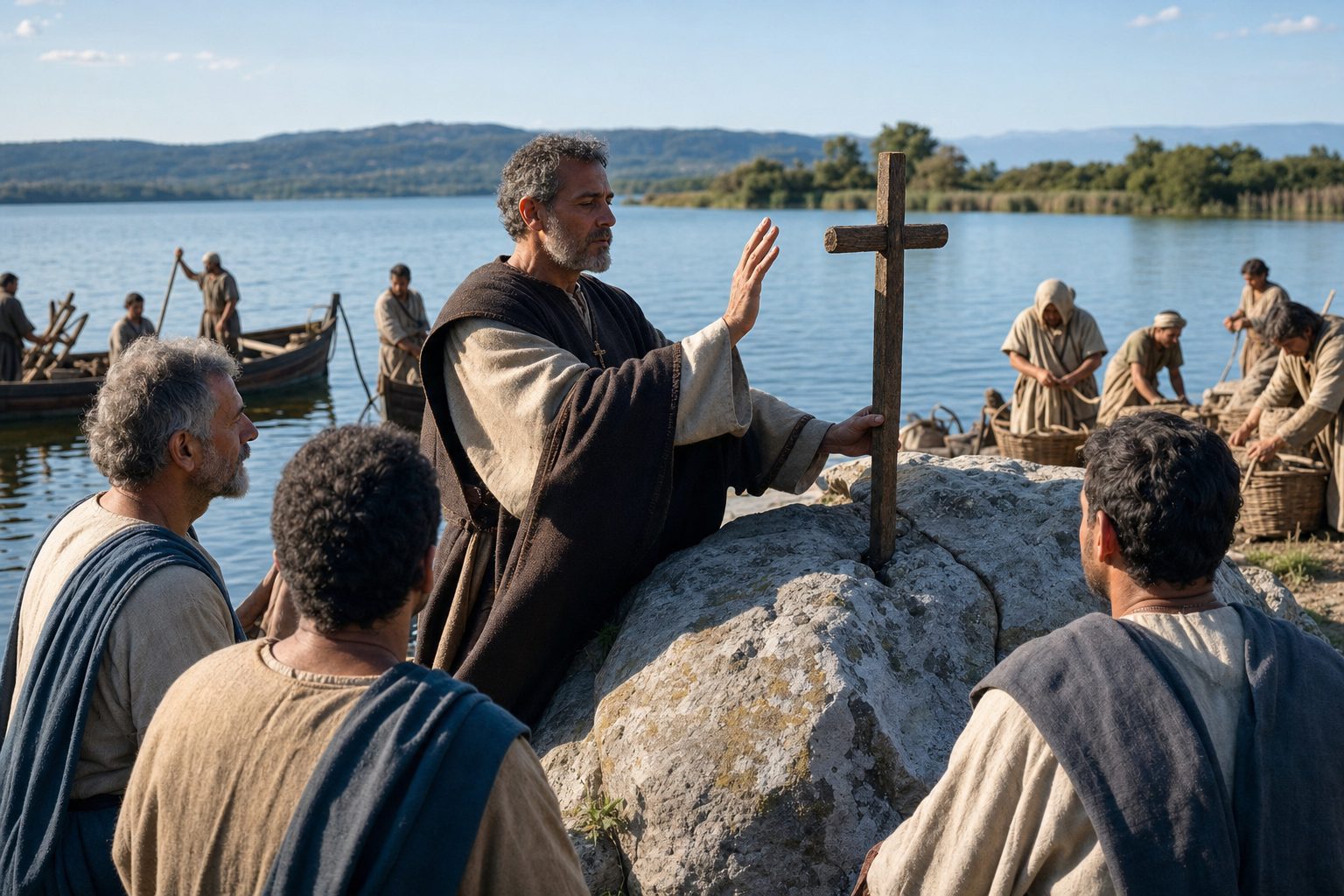
But the island was full of snakes and vipers, and no one dared to go near the island. So the saint went up to the rock, made a small cross of wood, and sat on it on a small rock.
"You have lived here long enough. Now, in the name of the Holy Trinity, the Father, the Son and the Holy Spirit, I command you to leave this island and make room for the house of God and for the servants of Christ who wish to dwell here.
When the saint had said this, all the snakes and vipers, as if they had understood his words, immediately obeyed his command, and, gathering together, retreated to the western side of the island; then, having plunged into the lake, they swam to the other side to the mountain called Kamunkin, and the mothers settled, making nests, and the island was cleansed of the vipers.
The saint, as he had done the first time, went to the Christian villages nearby and, after receiving help and everything necessary, returned to the island in boats with the workers; then, having laid the foundation of a church in the name of the twelve apostles, he began to build it.
And it came to pass at that time, when St. Julian, his brother, had finished building the church, which was near the city of Gaudíana, that he thought to make a coffin for his brother, and he began to build it.
"Behold, brother, with God's help and your prayers the church is finished, but a tomb is being built for you, so that your body may rest in it". But St. Julius, full of the gift of prophecy, said to St. Julian, "Hurry and finish building this tomb, for you yourself will have to rest in it". And this happened. When the tomb was ready, St. Julian the deacon turned to the Lord.
And St. Julius, having buried his brother's body with honor, returned again to the island, where he continued to build a church dedicated to the apostles.
And it came to pass at that time, that a certain senator, whose name was Aubentius, a man of noble birth, and virtuous, and godfearing, was appointed bishop of the whole country by the king at Medeolanum; and when he had heard of St. Julian, he desired with his household to go to the island of Mucorus, to see the man of God, Julius the presbyter, and the church which he had built; and he got into the ship, and departed.
And when he was come down, and had seen the temple, he said, Father, if thou wilt build anything, tell me, and I will build thee; for I will gladly be thy servant.
"Chado, we have nothing more to build, except a tomb for you near my grave, for your body will be buried in this church when you die". Avendentius replied, "Let your coffin, father, be here, and I have already made a tomb for myself in Medeo". "Believe me, child", said St. Julius, "your body will be buried near my body, and not in any other place".
After a long conversation with the saint and his blessing, he returned to Medea. In a short time, St. Julius was buried in his tomb, where he was given many healings by his prayers.
After a few years, Aventius, Bishop of Mediolanum, died, and was buried in his coffin at Mediolanum; but on the morning of the next day he was found lying outside his coffin, not thrown out by anyone, but as if taken out of it and carefully laid.
And they sought to lay him in another place, but there was no place to bury him. Then the household remembered the words of St. Julius, which he had spoken to Audentia, that he would be buried in no other place but beside his body; and they carried the body of Audentia to the island of Mucoros.
To the glory of our God and Father, and of the Holy Spirit, who is to be praised forever and ever. Amen.