The phenomenon of a miraculous icon of the Most Holy Mother of God, called the Tichwin
The memory of June 26
In the summer of 6891, from the creation of the world, and from the incarnation of God the Word in 1382, in the reign of the great prince Dmitry Ioannovich [Dimitry III Ioannovich ruled in Moscow with the title of great prince from 1363 to 1389], under the holy metropolite of all Russia Pimen [Pimen ruled the Russian metropolis from 1382 to 1389].
In the time of the Roman Catholic Archbishop of Novgorod, Alexius, the most venerable icon of the Blessed Mother of God appeared in Russia, with the image of her infant, our Lord Jesus Christ, on her left hand.
Within the Great Novgorod, a short distance from the Varyag Sea, fishermen fished in the waters of the great Nevo Lake.
And while they were fishing, suddenly a bright light from heaven shone on them... and when they looked up, they saw a marvelous miracle: an icon of the Virgin Mary, shining like the sun, was carried by invisible hands, walking through the air above the water.
And when they had left their work, they cast their eyes on the miracle which they had seen, and sought to see the way of the holy image, but God did not grant their desire, and the image was hidden from their eyes.
After that, the icon of the Holy Mother of God appeared in the same Novgorod borders, in the village of Vymochenice, on the Oyati River [Oyati - the left southern tributary of the Sviri River, which emerges from the Onjega Lake and flows into the Ladoga from the eastern side of it.] , a hundred fields [Poprishte - the measure of distance].
In ancient Russia, the field was equal to almost 656 current seedlings.] from Tihvin [Tihvin - city of Novgorod province].
And the people of the city gathered together, and were astonished at what they saw, and they lifted up their voices and prayed to the Most Holy Mother of God.
With great joy, the inhabitants of Vymotenitsa accepted the icon of the Queen of Heaven and immediately with diligence created a chapel in her honor, in which they placed their image; later on the site of this chapel a temple was created in memory of the glorious birth of the Most Holy Mother of God.
Here, in the village of Vymotenitsa, the icon stayed for some time, giving many sick people, with faith flowing to her, healing.
But after a short time, she was taken from there by an invisible hand and, unable to fly, appeared in the town of Kozela, near the river called Pasha [Pasha - a river that flows into the Ladoga lake at the mouth of the river Sviri.
It flows through the northern Petersburg and Novgorod governorates in the middle between the rivers Oyat and Tichvin.] , twenty streams away from Tichvin, - appeared exactly the same as in the aforementioned village.
When they saw her shining with a miraculous light, the people of the town gathered together, filled with wonder and terror, and prayed fervently to the Most Holy to grant them mercy and to send down her icon upon them.
The icon descended from the height to the ground, and the local inhabitants in turn created a chapel in her honor, on the site of which a church was later built in memory of the cover of the Most Holy Mother of God.
But even in this place, she did not allow her icon to stay long: after some time, she was taken from there again invisibly and visited several other places with her gracious appearance.
In all these places, marked and consecrated by the presence of the miraculous image, the diligence of the believers created first chapels, and later temples of God.
The sacred icon moved from place to place like a light cloud carried through the air, until it finally stopped near the city of Tihvinka on the river Tihvinka [Tihvinka is a tributary of the river Сясь, which flows into the Lake Ladoga from the south-east.]
And this last apparition was performed in exactly the same manner as the first: the holy icon, like a cloud, floated in the air and then became, miraculously in the air.
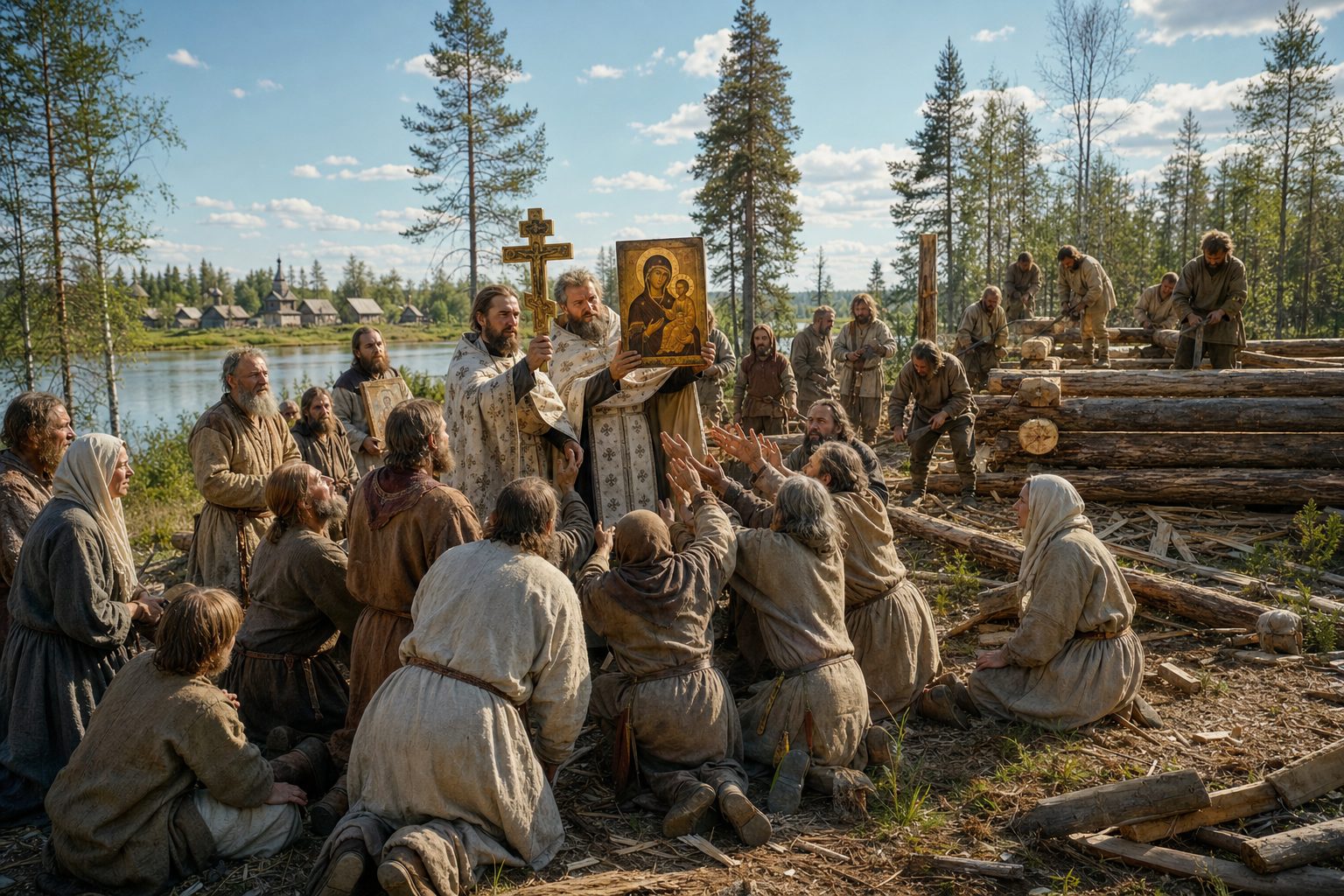
A large crowd from Tychinea and the surrounding villages had gathered at the scene, and the priests with them were carrying crosses and icons, and they were praying and singing hymns to the miraculous image for a long time.
"Come to us, Queen, come to us, Mistress, look upon us, your unworthy servants, pour down upon us the bounties of your humanity, visit us from above and enlighten those darkened by sin with your luminous coming.
And when they had prayed with much weeping, the holy image came down from heaven upon their hands, and was received by them with reverence and joy.
On the same day, they placed three wreaths around the clock tower and placed them around the icon. When the night came, the assembled people dispersed to their homes, leaving a few people around the miraculous icon so that they would spend the night in prayer.
And when they were asleep, there came a miracle, and the miraculous icon and the foundation of the chapel were moved as if by the command of God.
And all the timbers that were prepared for the building of the chapel were carried with it; and not only the timber, but also the pieces, even the smallest, were carried away by an invisible hand, so that none of the watchmen saw or heard it.
When they awoke, they found no statue of the Blessed Virgin, no foundation of the chapel, no trees for it, and they were filled with great sorrow and horror.
In the morning, the inhabitants of the area gathered again to worship the most venerable icon of the Virgin Mary and to build a chapel in her honor.
They related how they had spent the whole night in prayer, how they had not slept for a long time in the morning, and how when they woke up they found no icons, no trees, no stones, taken to an unknown place, and then they were filled with great sorrow, mourning that they had lost such a precious spiritual wealth.
With tears and tears, they began to pray to God: "O Lord, the Lord of humanity, send us again your divine gift, which you have sent to the Russian land with humanity and glory; do not hide from us this priceless treasure, which we hope to enrich our spiritual poverty.
O Lord, Mother of Mercy, where did You take away from us Your unworthy children? Yesterday You filled our hearts with joy by Your coming to us, and now You have brought us to our endless sorrow by Your departure, and have given us tears and tears.
And when they had said this prayer, they were scattered about the mountain, and over the thickets round about, looking to the heavens, and to the earth, to seek the image; and their earnest search was not in vain.
Soon they saw a marvelous light coming from the east, across the Tihvinka River, from a swampy forest desert almost two stadia away from the mountain.
Seeing the light, the people immediately rushed towards it and found the icon of the Holy Mother of God there, along with the foundation of the chapel and all the logs and chips from them.
And when they saw the image, they fell down before it, and gave thanks to God, and to the Blessed Mother.
Praise be to thee, O Christ, God, who hast not forsaken us, thy servants. We beseech thee, forsake us not, but be ever with us, saving and preserving the flock of thy Son.
After praying, all the people finished the construction of the chapel, and then, having elected the most worthy men, sent them to the great Novgorod to the most exalted archbishop Alexius and the city governor of Novgorod, with the news of the glorious appearance of the icon, which, unlike angels in the air, is not known where it came to them.
When the archbishop and the city governor heard the story of the great miracle that had taken place in Tihvin, they were amazed and, filled with spiritual joy, they glorified God and His Mother.
Then the most exalted Alexios ordained several presbyters and deacons for Tikhvin and sent them away, along with the husbands who had come to him, - giving them antiminus and his blessing for the creation and consecration of the church on the river Tikhvinka, in the name of the Assumption of the Blessed Virgin Mary.
When they arrived at Tihvinka and prayed before the miraculous icon, they began to build the church with zeal.
In the hope of consecrating the temple on that day, they sent out to the surrounding villages, every twenty or more, a message to announce to the Christians the day of the consecration of the church and warn them to prepare themselves by fasting and prayer for the coming celebration.
And the name of the man was George, a righteous man, a godly man, and a man of good cheer.
On the eve of the feast of the Assumption, as he was returning to the church, and was three miles from it in a forested wilderness, he smelled a strange odor, as of a multitude of incense and spices; for the grace of the Holy Ghost had overtaken the place where he was to appear.
The Blessed Virgin.
George was amazed and began to wonder where in the desolate desert such an unusual fragrance came from, and suddenly he saw the Blessed Virgin Mary sitting on a fallen pine tree, holding in her right hand a red staff on which she seemed to lean.
And there before her stood a bright man, clothed in bright robes, and resembling the face of St. Nicholas of Myra, and when he saw this strange sight, he was filled with fear and trembling, and fell to the ground as a dead man.
"Get up, and be not afraid!" George rose with trembling and joy, got down on his knees and, placing his hands on his chest, gazed at the strange vision.
"Go to my church and tell the priests and all the people not to put on it the iron cross they want to put, but let them put a wooden one instead. That is my will".
But the priest who was standing by said to him, "If they do not believe you, a sign will be given to them to convince them".
Then he was convinced that he had seen a miraculous vision of the Blessed Virgin Mary and the great saint Nicholas the Wonderworker.
And he went into the church, and told the priests and all the people, what he had seen and heard; but they believed him not, and commanded the servants to put the iron cross before the church.
But as one of the workers took up a cross at the priest's command and climbed onto the roof of the church to set it up, suddenly a great storm and strong wind arose.
With a gust of wind, the man with the iron cross was picked up as if by his hands and placed on the ground, without the slightest harm to him, as if he had not fallen from a height, but had descended to the ground himself.
When the chief priests and all the people saw what had happened, they were filled with fear, and they believed the young man's words and praised God and his most holy mother.
Then, having immediately erected a wooden cross, they placed it over the church, and with great joy and rejoicing celebrated the consecration of the church and together the memory of the Assumption of the Blessed Virgin Mary.
After the consecration of the church on the river Tychwinka, the whole people went to the place where George had a miraculous vision.
After praying, they founded a chapel here in the name of St. Nicholas, and from the fallen pine tree on which the Most Holy Mother of God appeared to George, they made a cross and placed it in the chapel for all-people worship and veneration.
In the chapel there were many miracles, as well as in the church dedicated to the Blessed Virgin Mary, seven years later - and with God's permission, due to the negligence of the church servants, a fire broke out in the Church of the Mother of God in Tichva from an unquenchable candle.
The whole church was reduced to ashes, but the miraculous icon of the Blessed Virgin remained unharmed: by the invisible power of God, it was taken out of the fire and found not far from the place, at a distance of half a yard [i.e. at a distance of 328 sagenas (656:2).], standing in the moss.
At the same time, a fire broke out in the chapel in the desert, which was also engulfed in flames and burned; but a cross made of fallen pine and standing in the chapel was also carried out of the fire and was found a short distance from the chapel, which stood in a thicket of mulberry.
On the site of the burned church, another, also of wood, was built, and then a new chapel was built in the desert, on the same place; after this, the holy icon of the Pure One was placed in the church, and in the chapel a pine cross.
But five years later, the church caught fire again at night and burned to the ground, and the miraculous icon of the Mother of God, like an unburning basket [the burning but unburning Bush, seen by Moses on Mount Horeb before his call to be the leader of the Jewish people.
The Virgin Mary, who did not change her virginity at the birth of her Son, was found intact and unharmed in the ashes, and the chapel in the desert burned, but the miraculous cross in it remained intact.
Then they hurried to build a third church, again of wood, but larger and grander than the first two.
This newly created church existed for more than a hundred years before the reign of the pious prince of all Russia, Vasily Ioannovich [Vasily IV Ioannovich, father of John the Terrible, prince from 1505 to 1533].
Moved by great jealousy and love for the Virgin Mary, Grand Duke Vasiliy ordered a stone church to be built in the place of a wooden one.
The money they had sent was soon put on a stone wall, and when the builders began to bleach it, the building, by God's unfathomable fate, collapsed and was covered with the stones of the twenty builders.
And the priests, and the officers, and all the people, wept exceedingly, because they stoned the builders; for they said, They are all stoned to death. And they threw stones at the bodies, weeping and mourning.
But after three days' work, they scattered all the stones, and found them all alive and unharmed.
And they gave thanks to God and to the Blessed Mother, and began to work again, and soon the church was built.
When the construction of the new church was completed, the consecration of the church was attended by Serapion, the archbishop of Novgorod, who, after consecrating the church, honorably brought in the miraculous icon of the Holy Mother of God.
After some time, the great prince Vasily Ioannovich arrived in Tihvinka, attracted by his love for the Blessed Virgin Mary, he wanted to see and kiss the miraculous icon of the Blessed Virgin, as well as pray in front of it and see the newly created temple.
At that time, the archbishop of the great Novgorod was the most exalted Makary, who by the will of God was then elevated to the throne of the Moscow metropolis [Moscow metropolis he occupied from 1542 to 1564].
He accompanied the grand prince on his journey and, together with him, arrived in Tihvinka, where they prayed fervently before the icon of the Most Holy, performing many services and prayers, and then left - the archbishop to Novgorod, and the grand prince to Moscow.
According to Vasily Ioannovich, his son, Ioann Vasilievich, became the Grand Duke of Moscow [Tsar Ioann IV Vasilievich by surname Grozny, first married to the kingdom and took the title of king, reigned from 1533 to 1584].
Like his father, he had great zeal for the miraculous icon of the Most Holy Mother of God, which is in Tihvinka, and as a once-faithful prince Vasily Ioannovich, he came there to worship.
Seeing that the church was headed by lay hierarchs and deacons, and that numerous villages were located around it, king John Vasilievich found this unseemly and decided to found a pagan monastery here.
After consulting with Metropolitan Makarios of Moscow, Novgorod Archbishop Pimen, as well as with his own princes and boyars, he ordered all the surrounding villages and the priests who were at the church to be moved to another place, far away from the church, and at the church - to settle the monks far away from the church.
The church, and the church, to settle the nuns and start building a monastery.
A little later, a monastery was built in Tihvinka, built entirely of stone and surrounded by stone walls, with a dormitory, as in other great and glorious monasteries.
The first abbot of the newly created monastery was Kirill; under him many monks, attracted by miracles from the icon of the Most Holy Mother of God, began to leave their deserted dwellings and come to the Tichvin Monastery.
One of the first to come here, while the monastery was still being built, was the monk Avraham, who had previously lived in the Sergius Monastery on the Great Locks, about five hundred yards from the Tichvin Monastery.
Then his mentor Martyr, a godly husband, hearing much about the miraculous icon of the Most Holy Mother of God in Tihvin, about the abundant healings given by her to the sick, advised Abraham to make a vow to the Most Holy to go to Tihvinka and pray there before the miraculous icon.
The sick man did so, and at once he was cured of his illness, and so he returned from the brink of death, standing up in perfect health and praising God.
His mentor Martyr rejoiced to see his disciple's quick recovery and was amazed at the amazing miracle of the Mother of God.
And Abraham went on his way, and when he had come to the place of peace, he bowed down before the image of the Virgin, and wept, and kissed it, and worshipped it with all his heart.
At this time, the archbishop of Novgorod, Pimen, was on the river Tihvinka, watching the work on the monastery; the news of Abraham's miraculous healing reached him.
The saint was filled with joy and praised the Lord and the Virgin Mary.
He did not want to let Abraham go back to his mentor Martyr, but handed him the keys to the church so that, in gratitude for the ineffable mercy of the Mother of God, he would be the first to come to her temple and the last to leave, opening it before the beginning of the services and closing it at the end of them.
And when the old man had sent Abraham away, he was grieved that he himself had not gone with him to worship the image of the Blessed One, and he decided to go to the Tomb when his disciple returned, and after waiting for him a long time, the old man began to worry about him, and then he saw a vision in his dream.
On the side where Tihvin stood, a large pillar of fire rose before Martyr's eyes, on the top of which was the image of the Most Holy Mother of God, shining like the sun and a view similar to the one in the Tihvin Monastery.
In this mood he awoke, and at the same time he became even more eager to see and touch the miraculous icon of the Most Holy Mother of God, which is near Tihvin.
When he reached the sanctuary and saw the image of the Blessed One, he fell down before him in awe and wept bitterly.
At the same time, he saw his pupil perfectly healthy and after that he did not want to return to his monastery, but stayed in the Tihvin Monastery, so that he could daily contemplate the miraculous image of the Virgin Mary.
But after some time, Martyr, by the will of God, was transferred to another desert place forty furlongs from Tihvin, where the aforementioned Avraham once saw a cross in the sky, made of stars and illuminating the whole area.
Moving there, the blessed Martyr took with him the list of the miraculous icon of the purified and remained here in silence, working day and night for God; the list of the miraculous icon of the Mother of God he always carried with him wherever he went.
And one day he had to be in the city of Tver, where by the order of the good-hearted king and great prince Ioann Vasilievich, the Kazan king Simeon lived.
At one time (in 1574) Grozny placed him on the tsar's throne instead of himself, although, of course, Simeon was considered a king only in name.
While the elder Martyr Simeon was in that city, his son John, who had been ill for a long time, died, and St. Martyr placed an icon of the Virgin Mary on the dead man, and the dead man immediately rose again.
Simeon was filled with great joy and praised God and His Blessed Mother. Then, wishing to thank the blessed Martyr, he built his stone church in the desert and built a monastery near it.
But we will now turn to the Tichwin Monastery and the miraculous icon of the Most Holy Mother of God, which appeared in Tichwinka, to tell about other miracles.
Many miracles were wrought by the holy icon at that time, and not a few healings were wrought by her to all who believed in her, miracles which no contemporary has recorded for the instruction of future generations; and so we are deprived of the possibility of knowing anything about these miracles.
But even when the monastery was erected, not many of the former miracles of the icon were recorded, partly out of simplicity, partly out of neglect, - and these are not many that have come down to us and are gathered, like a field of harvest, the remaining kernels, or after harvesting the grapes, the few clusters accidentally left in place.
Now there was a man named Theophilus, who had been blind for four and a half years.
Now there was a boy named Zechariah who had been blind for five years and was cured.
And there was a man named Clement, who dwelt in the city of Moscow, and his wife, whose name was Paraskeva, lay sick a year upon her bed, and could not get up; and her eyes became dim from the pains, and her mind darkened.
Her husband had tried everything to cure her, and he was desperate to save his wife, but he heard that there was a miraculous icon of the Blessed Virgin in Tychwina, which heals all who come to her in faith.
When the hope was fulfilled, he began to persuade his wife to make a vow to the Most Holy Mother of God that she would go to worship Her icon of Tihvin.
And it came to pass, when she had said the words of the vow, that immediately she rose from her sickness, as from a sleep; and she was healed of her sickness, and her limbs were strengthened, and she was healed; but her sight was not restored.
Then the husband and the healed wife immediately went to Tihvin, jointly fulfilling the vow given to the Most Holy One, Having reached the Tihvin Monastery on the first Saturday of the Great Lent, they went straight to the church to the icon of the Most Holy One and prayed before the holy icon, creating a prayer song.
While they were praying in the temple area on Sunday night, a new miracle occurred: By the grace of the Most Holy One, the woman received her vision and thus became completely healthy.
All who were in the church, seeing this miracle, with tears of consolation, praised God and His Most Holy Mother.
In 1586, a blind man named Georgy was brought to the image of the Most Holy Mother of God in Tihvin, and when he prayed in front of the miraculous icon on the Feast of the Holy Mother of God, he could see with his right eye.
And he went home without help, praising Christ Jesus and His Blessed Mother for healing his one eye.
A few days later they brought the monastery to the miraculous figure of the human Lady, named Andrew; he was relaxed, and at the same time deaf and dumb, and had been in such ailments for fifteen years.
When they prayed for his healing before the Most Holy Icon, he was instantly healed: his hearing was restored, his speechlessness was healed, and all his limbs were strengthened, so that he stood on his feet like a healthy man.
A similar miracle was performed on a certain woman, Mavra, who lived at the mouth of the river [The mouth of the river <unk> of the Yaroslavl province, together with the Veksha river forms the upper reaches of the river Kotorosti, the left tributary of the Volga, where it flows into the Yaroslavl itself.]
She had been blind for seventeen years, but when she was brought to the miraculous image of the Pure One, she immediately received her sight.
That same year, on March 4, a young boy named George was brought to the Tichvin Monastery from the great city of Novgorod. He had been possessed by an evil spirit for six years and suffered terribly from it.
When he was brought to the image of the Pure One, the dark spirit, not bearing the light of grace emanating from the miraculous image, withdrew from the sick man, disappearing like darkness before the sun, and the boy became perfectly healthy.
A widow named Juliani suffered from an eye disease so severe that she was blind and could not see the light of God for two years.
When she heard of the miraculous icon of the Most Holy, which was near Tikhvin, and of the unspeakable healings which it brought to men, Juliana was filled with fervent faith in the Most Holy, and vowed to go to the icon to worship her.
Immediately, wanting to quickly repay the gratitude of the Most Holy, she, being a sighted person, without any outside help went to the Tikhvin Monastery of the Most Holy and, fulfilling her promise here, announced to everyone about God's mercy shown to her.
At about the same time a cripple named Aquinas, who had been unable to walk for two years because his legs were crumpled, crawled on his knees to the miraculous image of the Blessed Virgin Mary.
He stood up and walked, thanks to Christ and His Holy Mother.
That same year, on August 10, a blind young man named Jonah, brought to the holy monastery from the great Novgorod, received a vision from the image of the Most Holy Mother of God.
Another young man, named Maxim, possessed by an evil spirit, when his parents led him to worship the image of the Most Pure, still on the way received heavenly help from the Most Blessed Mother of God: by the power of God the evil spirit was cast out of him, and he, coming to the monastery of Tihvin, told everyone about what had been created over him
It's a miracle.
In 1591, a woman named Elena, who had been completely blind for two and a half years, so she could not see the light, was able to see in a miraculous way in front of the Blessed One in one of the resurrections, at the liturgy, while singing: "It is worth to eat"...
In 1593, another woman, named Mary, was brought to the miraculous image of the Blessed Virgin Mary on the Feast of the Assumption.
There was also a man named Clement, a silversmith, who was blind. When he prayed at the temple, he was healed.
Another blind man, named Philip, who had not seen the light for 5 years, was brought to the Tichvin monastery during the Orthodox week, standing and praying here in front of the icon of the Most Holy Mother of God, completely despised and began to see everything clearly.
It happened in the year 1596, during the liturgy, when the holy gifts were being carried from the altar to the holy throne, that same year, a man named Kirill, blind in one eye, came from Moscow, and while praying before the icon of the Most Holy, he received a vision.
After suffering from a serious illness and constant headaches, he became blind in both eyes, was blind for six months, and had no relief from his illness, although his loved ones took great care of him.
He was desperate to be healed when his wife had a dream in which she heard these words:
"Tell your husband to go to the sacred shrine of the Virgin Mary, where he will be healed, or else he will suffer even more".
He immediately began to pray fervently to the Most Holy Mother of God and at the same time made a vow to the Queen of the heavenly pure Mother of God to go to Tihvin to worship Her icon; then he got relief from his illness: he began to see light with his own eyes and even became completely healthy.
And when he delayed [his vow] from day to day, he forgot [it], and he did not perform [it], and the word of Jehovah seized him again for his neglect, and the plague returned to him after a time, and he was blind [again].
Then, remembering his unfulfilled promise and realizing his sin, the patient began to weep, weep and repent, and again turned with a prayer to the Most Holy Mother of God, assuring Her that he would fulfill his previous vow.
By the mercy of the Most Blessed Queen of Heaven, he was healed a second time, but this time he could only see in one eye, while the other one remained blind.
Without delaying the fulfillment of his vow for a long time, he immediately went to Tihvin, and having seen there with one eye the icon of the Precious, after praying in front of it, he saw with the other eye.
After offering a prayer of thanks before the miraculous icon of the Immaculate Virgin Mary, they told the following about themselves.
When they reached a deserted place, the waves overwhelmed them for a long time.
And when each of them was about to die, they began to pray to God for forgiveness of their sins, and they remembered the miraculous icon of the Holy Mother of God on the Hill and began to pray fervently to her.
The next night, one of them, a little drowsy in the midst of prayer, was visited by the Emergency Helper, the Blessed Virgin Mary, who ordered him to tell all his companions to eat some grass that grew there, and then to sail to their homes by sea until their time was right.
And he told [it] to all the men that were with him; and they tasted of the herb that was shown to them, and their taste was as the taste of bread; and they ate herb like the manna that the children of Israel had in the wilderness, twenty days, until the plague was removed.
A short time later, a woman named Elena came to Tihvin and told the following about herself.
She was blind for three years, but one day, motivated by her faith in the Pure One, she ordered her to behave towards the Tichvin icon of the Mother of God, and when she was on the way, she suddenly saw, reached the monastery without outside help, here they rendered grateful worship to the Mother of God before her miraculous icon.
Similarly, one man, named Mamant, came from the borders of Belozers [Belozers was located near the White Lake, which is located in the north-eastern corner of the present Novgorod province.
It was in 1597 that he was blind for a long time, but as soon as he vowed to go to Tihvin and worship the miraculous image of the Pure One, he immediately regained his sight.
Another man, Diomides, came from the same country and in the same year to the Monastery of the Most Pure and also told about himself that he was relaxed for a whole year, but then, remembering the Tichinsky miraculous icon of the Most Pure, he began to pray to her mentally and vowed to go to worship the most pure image:
Immediately the servant was healed, and he did as he had promised.
A man from Pemaeus was there who was possessed by a demon, and his relatives sent him to Tyre. They bound him with chains, and while they were on the way, the demon left him and he was healed.
It's mine.
On December 9, a man named Kodrat, who was suffering from a headache, had been blind for a year and a half and had not seen the light, heard about the miraculous icon of the Virgin Mary near Tihvin, prayed fervently and vowed to go to her to worship.
And when he had said the words of his vow, he immediately received a vision, but when he had postponed the journey until another time, he soon forgot all about his vow and did not go to thank his Healer, the Blessed Virgin Mary.
And it came to pass at the end of ten years, when he had seen, that he was as blind as before, and he remembered not his promise, until he saw a vision in his sleep, and he was admonished; for he saw a man saying unto him,
- Go to Tihvin to worship the image of the Pure One; if you do not go and do not fulfill your promise, you will not get a vision of your eyes Rebellion from sleep, he remembered his promise and knew his sin; immediately he went to the Tihvin Monastery of the Mother of God, accompanied by a guide.
But when he was brought to the miraculous image of the Most Holy and prayed before him with all his heart, he was instantly healed by the mercy of the Most Holy Mother of God.
There was a man named John, who had been ill for a long time and was near death. Nicholas, a saint of Christ, appeared to him in a dream and said to him, "If you want to get well, make a vow to the Most Holy Mother of God and go and worship her miraculous image that is in the Abyss".
And when the man awoke, he prayed to the Most Holy One, and vowed to worship her image, and he was healed, and went to the monastery, fulfilling his vow.
In the same year, a blind woman named Mary, who had been blind for ten years, was brought to the monastery; after praying before the icon of the Most Holy Virgin, she received her vision.
Another woman, named Eudocia, who lived in the Onega Lake [Onega Lake is in the current Olonetsk Governorate on the north-east of Lake Ladoga.], being demented and relaxed and having at the same time also a dry hand, as soon as promised to go to the image of the Pure on
At once the evil spirit left her, and she was cured of her disease. Her hands and feet were completely restored, but she was not healed.
When she came to the monastery of Tihvin and prayed to the Mother of God before her image, then her hand became healthy.
A lame and blind man, named John, vowed to worship the image of the Blessed Virgin and was healed in his home: he regained his sight and his feet stood upright; then he came to the Tikhvin Monastery to give thanks to the Blessed Virgin on March 1, 1606.
Similarly, many other people who were afflicted with various ailments were immediately healed as soon as they made a vow to worship the miraculous image of the Most Holy Mother of God on the Tihvinka River.
"We know", says the Tychwinian chronicler, "that from this sacred image never ceased to be wrought ancient miracles, and always poured forth with faith, as from a fountain of living water.
Many who were blind received their sight; demon - possessed people were freed from their diseases; deaf people could hear, the lame were cured, dumb people spoke plainly, sick people could walk and leap and those suffering from headaches were healed.
Even in distant lands, those who were possessed by various diseases, as soon as they made vows before the miraculous icon, were not deprived of its immediate help.
During the reign of the pious Tsar and great prince Vasily Ioannovich of Shuy [Vasily of Shuy, elected by the boyars after the overthrow of Lzhedimitry I, reigned from 1606 to 1610] there was, through our sins, great turmoil in the Russian land, partly from internal inter-relationships, partly from attacks from outside.
The enemy.
Russian blood was spilled everywhere. The reigning city of Moscow was in the hands of non-believers, and the Great Novgorod with all its region was owned by the Varangians.
But now, by the mercy of God and the all-powerful help of the Heavenly King, the scattered Russian troops, gathering into one militia, took from the heathen the reigning city of Moscow, and in it reigned the pious king and great prince Mikhail Feodorovich [Mikhail Fedorovich Romanov, elected to the throne by the earth council from
All of Russia, ascended the throne in 1613.
He sent his troops into the great city of Novgorod against the Varangians, and here, at the river Usty, a battle took place between the Russian troops and the vanguard of the Varangians.
The Varangian warriors were defeated and fled; the tsar's troops overtook them at the river Tihvinka and partly killed, partly captured.
Upon hearing about this defeat of the Varangian warriors, the Varangian voivode, who was sitting in the Great Novgorod and had numerous Varangian regiments in it, was filled with great anger and fury.
Wanting to avenge the Russians for this defeat, he sent his regiments, who were in Novgorod, to the Tichvin Monastery, to finally desolate and ruin it, with all the surrounding villages.
On hearing this, the surrounding inhabitants gathered with their wives and children under the shade of the monastery and, together with nuns and a few royal soldiers, hid behind its strong stone walls, locking themselves there from the Varangians.
And all of them hoped not so much in the fortress of the walls, but in the help and intercession of the Unbreakable Wall and the Veil of all those who trust in it.
Those who were locked in the monastery were terrified, and while some were on the walls fighting the Varangians, others, gathered together with the nuns in the church, with tears prayed fervently to God and the Most Holy Mother of God before Her miraculous icon, making all-night vigils and begging the Most Holy Mother of God
I want to help the Orthodox Christians.
And this help didn't slow down to come to them. That same night, a woman named Mary was sleepwalking while praying.
"Tell everyone in the monastery to take my icon and walk with it around the walls of the monastery, and then they will see God's mercy upon them". Immediately awakening from sleep, the woman told about the vision to everyone in the church.
They were filled with joy and hope for help from above and, taking the miraculous image of the Blessed Virgin with prayer, they carried it to the monastery wall; making a litany, they began to go around the monastery and at the same time with tears they called to the Blessed Virgin:
Thou, Queen of the heavens, hast seen the affliction of thy servants; and deliver us from our oppressors, and shew thy hand, that all our enemies may know that thou art our oppressor. And great fear fell upon our enemies in that hour, and they were dismayed; and they fled every one from his dwelling-place, and there was none to pursue them.
But after some time, the Varangians approached the monastery with even greater force and, having besieged it, again led a siege and made repeated attacks on the monastery.
During the siege, the monastery was crowded with both sexes, with men and women living in close quarters, not all of them maintaining proper cleanliness for the sanctuary, and they became inflamed with passion, like hay from a fire spark.
And the people of the towns were enraged, and the Lord turned away from them, and the people of the towns were weakened, and the people of the towns became weak.
And all the inhabitants of the monastery were in despair, and thought that they were about to be destroyed by the besiegers; and they came to the miraculous image of the Virgin, weeping bitterly, and exclaimed before her, and said, Thou hast seen our humility.
With tears we come to your pure image and we humbly beg: do not abandon, O Holy One, your holy abode, which you yourself have begun here by the appearance of your miraculous icon.
And do not forsake your servants. We seek no help except from you.
At this time, the monastery was inhabited by Martinian, a devout and God-fearing monk, who saw a vision of the Blessed Virgin surrounded by the saints Nicholas the Wonderworker, St. Zolamus of Houtyn and St. Varsima of Solovetsky.
My help was withdrawn from this place because many had defiled it with their unclean practices.
Upon hearing the story of the Solovetsk minister, the authorities immediately sought out all the people who had polluted the monastery by falling into the power of unclean lust, and expelled them; then they cleaned the pretence of the church and began to please God and the Most Holy Mother of God with many earnest prayers, shedding abundant tears and prayers.
And ask forgiveness of the Most Holy One, so that they will not be handed over to the enemy.
And the loving Lord, at the intercession of His Immaculate Mother, turned His righteous wrath to mercy on the perishing, and from that time on the besieged grew stronger and stronger, while their enemies began to weaken.
Finally, having gathered their forces and hoping for the help of the Pure One, the besieged suddenly came out of the monastery wall and, rushing towards the enemies, courageously entered the battle with them.
The help of God, but the prayers of the Most Holy Mother of God, hastened them, and the Lord gave them the victory over the enemies, for although they were few, they drove away many thousands of enemies and captured some of them.
To avenge their disgrace, they gathered even more strength and approached the monastery once more, besieging the monastery, often making furious attacks on its walls and digging underground pits under the walls.
And the king said to the princes of Israel, Take away the swine out of my house, for they have digged all around, and have digged the threshold of the house.
A similar apparition occurred to another man named Gregory, and both of them - Martinian and Gregory - announced the words of the Virgin to all present in the monastery.
That night the Lord gave the enemy a terrible vision: they saw a large number of armed soldiers coming from Moscow, with many bright horsemen carrying crosses.
But hoping to damage the monastery and its walls with their digging, they lingered for a while.
Meanwhile, the besieged, strengthened by vision, former Martinianus and Gregory, having prayed before the miraculous icon of the Virgin Mary, left the monastery, as before, armed, and rushed to their enemies.
The Lord, who was helping the Orthodox, put the armies of the enemy into confusion, and great fear and trembling fell upon them.
In confusion, they fled, and, in terror, they mixed and killed one another, pursued not so much by a few visible warriors as by countless invisible warriors.
When the Orthodox soldiers saw their enemies running, they grew even more bold and chased them with new strength, cutting them down like stems, and taking some captives; the same enemies who were in the trenches, the army that came out of the monastery partly struck with swords, partly fell asleep in the ground.
When the battle was over, the captured Varangians told that they had seen a large army come to the monastery's aid the night before, and that the same army had then come out of the monastery walls and chased them with great force.
When the Varangians heard this story, the Orthodox with tears gave thanks to God and the Holy Mother of God.
The next year, the Varangian commander, who was sitting in Veliky Novgorod, was furious against the Tichvin Monastery, where so many of his soldiers had died, he again gathered a strong militia and, sending him to Tichvin, ordered without any mercy to destroy the monastery to the foundation, and the icon of the Holy Trinity.
The Virgin Mary will be cut to pieces and the church will be thrown to the ground.
The news of his order reached the monastery of Tihvin, and all who were there were terrified and wanted to take the miraculous icon of the Holy Mother of God and flee with it to Moscow.
But the miraculous icon remained in its place, so that when the priests tried to lift it from the place of prayer singing, they could not do it.
And when they saw that they were in a state of distress, they said, 'We have no power to save you; we have no power to destroy you, but we have power to destroy you.'
And the people of the land saw a great multitude coming against them, and they trampled on one another, and fled.
From that time on, the Varangians no longer dared to approach the Tichvin Monastery [Mikhail Fedorovich Romanov, elected Tsar by the Zemsky Council from all of Russia, ascended the throne in 1613 and reigned until 1645].
So the Most Holy Virgin Mary defended her monastery with glory and not once from enemies, and not only her monastery She took from their hands, but also the Great Novgorod with all its borders She soon liberated from the Varangian yoke and handed it to the Orthodox Russian tsar.
And by her prayers, peace and quiet came to the whole Russian Empire.
After the aforesaid calamities, when the monastery was enjoying peace with the whole country of Russia, it was pleasing to God to visit the monastery, guarded from the attacks of the Varangians, with fire, to warn and cleanse its inhabitants of all impurities.
This terrible visitation of God was miraculously foretold by the brothers of the monastery. It was so. In Tikhvin lived a poor man named Nikita, who, to please God, took upon himself the feat of a Jew. And then, not in a dream, but in reality, the reverend Makarios Zeltovodsky appeared and said:
"Go and tell the bishop and the brothers to be careful to abstain and not to have anything drunk in the monastery, for drunkenness leads to all evils".
And let not the seducers enter your houses, and especially the women, and tell them to pray to Allah and the Holy Mother of Allah, that they may avert from you the torment of the Fire.
Then Nicetas, not knowing the saint, asked him who he was. He said, "I am Macarius of Zeltovod, and I came here to the miraculous image of the Most Holy Virgin". When he had said this, he disappeared. Nicetas went to the bishop and the brothers and told them about the vision he had had.
But they did not believe him, and they laughed at him as at a Jew.
The fire was so severe that not only the wooden buildings were reduced to ashes, but also many stone buildings were destroyed by the fire.
They repented and began to obey all that the saint had said, and they prayed fervently to the Most Holy One, asking Him to forgive their sins.
And by the mercy of the Queen of Heaven, the sanctuary, after some time, was again beautifully restored, and stands intact to this day, flourishing like a vineyard and glorified by the miracles wrought by the miraculous icon of the Most Holy.
For even now those who come to the monastery with faith receive before the icon what they ask for and receive miraculous healings of their ailments [The Tikhvin icon of the Mother of God is one of the most famous and revered icons of Her in Russia.
Russian princes and tsars enriched the monastery with their contributions and travelled to worship the icon themselves.
In both capitals, in many cities and monasteries and even in rural parish churches there are lists of miracles from this icon - In the Tihvin Monastery, 24 times a year a procession is made around the monastery with the miraculous icon.
The cost of the precious jewels on the icon is up to 70 thousand rubles.] We do not need to talk about all these miracles: they are recorded in the Monastery of the Most Pure to the glory of the Lord God and His Most Blessed Mother.
There is no reliable information about where the miraculous icon of the Holy Mother of God was brought to Tihvin.
In ancient manuscripts it is written that she came to Russia, by the will of God, from Greece, from Constantinople, in the reign of the Greek emperor John Paleologus, 70 years before the taking of Constantinople by the Turks.
It was destroyed by the Turks in 1453.
It was evident from the following circumstances, that at the time when the miraculous icon of the Most Holy Mother of God was beginning to be glorified in Tikhvin with many and great miracles, some Novgorod merchants, pious men, happened to be in the ruling city of Constantinople.
His Holiness the Patriarch of Constantinople remembered the miraculous icon they had, which had disappeared from the reigning city, and asked them: "Have they not heard of such an icon?"
Then they brought the matter before him and swore that they had spoken the truth.
"One miraculous icon of the Virgin", they said, "came to great Russia by air, God knows from where, and appeared there in various places, within the limits of the Great Novgorod, at a distance of one hundred and eighty square miles from it, passing from place to place; finally it appeared with glory on the river
Tishwini, where she performed wonders and unspeakable miracles, where she remains in the church today.
Hearing such a story and realizing that this icon, which appeared in Tihvinka, is the one he was asking about, - the patriarch began to sigh from the depths of his heart and ask more about the Tihvinka icon.
Then he told how the same icon, once glorious, had left the royal city by the sea, going to where God was pleased, and how, after some time, she returned to the royal city, and how many miracles and good deeds were done by her to the faithful, as well as gifts.
Praying to her as a powerful helper, victory and defeat of enemies.
"But now", he said, "because of our pride, our hatred of our brothers, and other untruths, she has certainly gone away from us again and will not return.
Having said all this with affection, the patriarch went with the Novgorod merchants to the church and showed them the place and the ark where the icon of the Virgin Mary stood.
The place was - if entering the church from the western doors - at the right pillar of the temple; here was placed another icon, but a smaller one, and burned an undying lamp.
When the men of Novgorod heard and saw this, they were greatly astonished and glorified the Lord God and His Most Holy Mother, who performed many miracles in various countries by means of her pure image.
For a long time they talked about the icon of the Most Holy Mother of God with the patriarch and told each other about the miracles performed by the Mother of God: he - about those that were created in Greek country, they - about those that amazed the Russian land.
And the Russian men rejoiced greatly when they heard the news they had received concerning the miraculous icon of the Blessed Virgin.
When they departed from Constantinople and reached the Russian land, then from them in all Russia became known what they heard in the Tsar's Palace, and briefly recorded the inquiries of the universal patriarch about the miraculous icon of the Mother of God and his story about the miracles that came from her and indicating to them the place where
The icon stood in Constantinople.
Ever since then, everyone has been convinced that this holy image is not another, but one that has left the Castle.
Therefore, like the Cathedral, the monastery of Tichvinsky had a place for the miraculous icon of the Most Holy Mother of God at the first right pillar at the entrance to the church from the western doors, - here it still stands, performing many and unspeakable miracles.
And since this miraculous icon of the Mother of God, which is in Tihvin, is called by some both Odigitria and Roman or Lydian, it will be fitting to mention here that there were two icons in the Kingdom Hall, one of which was called "Odigitria", and the other - Roman or Lydian.
So the Odygitrya is one icon, and the Roman is another, and these two icons are going to be briefly described here so that everyone knows about them.
22 About a year after this miraculous victory, the Tsar's ambassadors arrived at the Tichvin Monastery to conclude peace with the Swedes.
Here, on February 10, 1617, the Stolbovo peace was concluded, and the main guarantor of peace from the Russians was the list with the miraculous Tichvin icon.
This list was subsequently moved to Moscow and placed in the Cathedral of the Assumption, and then after a strong request of the Novgorodians, who participated in the war against the Swedes, was sent to Novgorod and placed in the Sofia Cathedral, where it is now.