The life, deeds, and sufferings of the glorious and all-powerful Supreme Apostle Peter
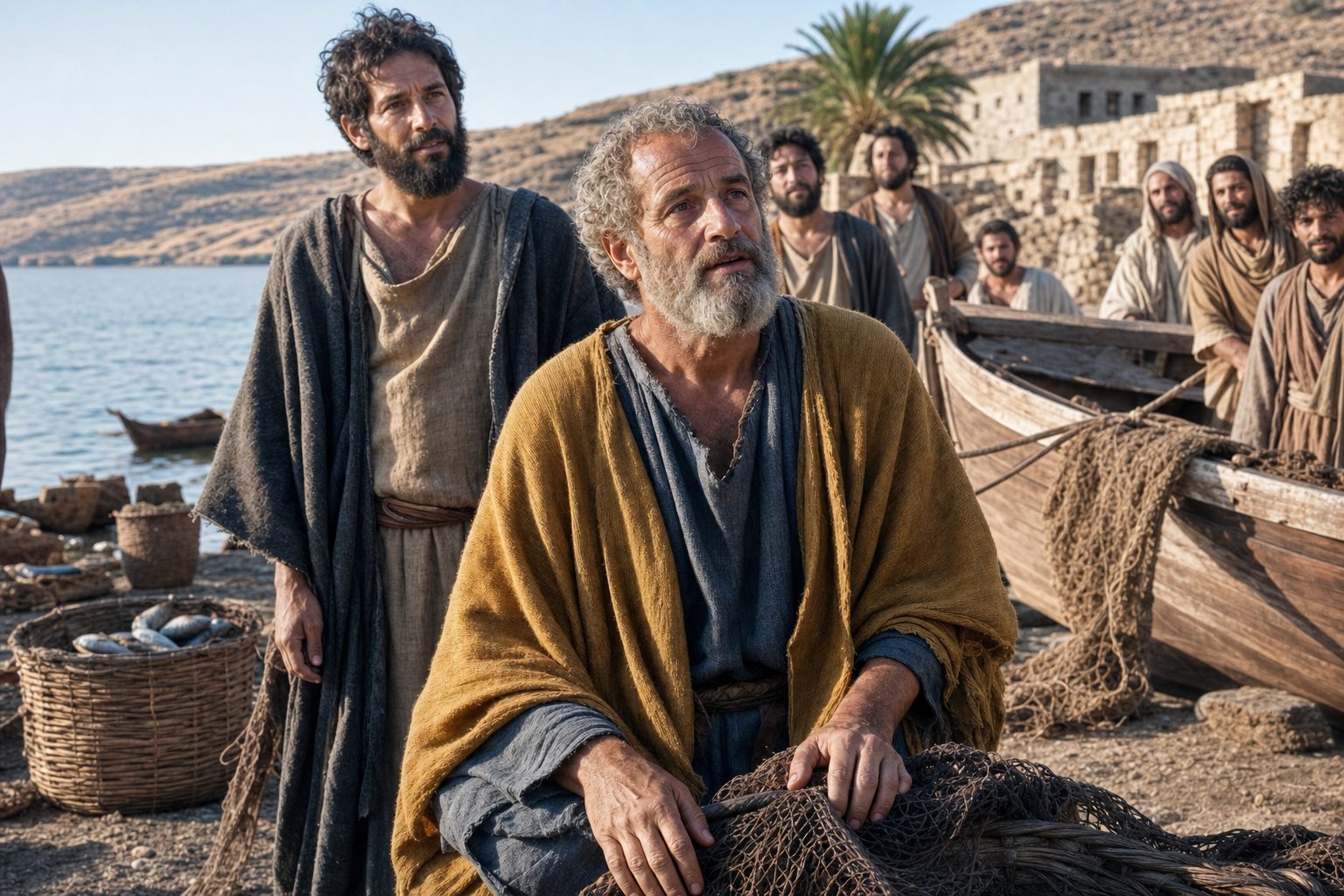
The memory of 29 June Brother of the first-born Apostle Andrew, the holy Apostle Peter, who before being called by the Lord Jesus Christ bore the name Simon, son of the Jew Jonah of the tribe of Simeon, was originally from Bethsaida, a small and little-known Galilee town in Palestine.
Simon was a man of integrity and uprightness; he feared God and kept all the commandments of the Lord, "walking faultlessly before him in all his dealings".
And Andrew, Simon's brother, neglecting the vanity of the rebellious world, set out on the path of celibacy: he went to the Jordan to St. John the Baptist, who preached repentance (Matthew 3, cf.), and became his disciple.
"Where are you staying?" Jesus replied. "Come and see. " So they went and saw where he was staying, and spent that day with him. (John 1:38-39) The next day Andrew first went to his brother Simon and said to him, "We have found the Messiah". And he brought him to Jesus. Jesus looked at him and said, "You are Simon son of John. You will be called Cephas" (which means Peter).
But he did not leave his house, nor did he forsake his business, to provide for his household the necessities of life; in this he sometimes helped Simon and his brother Andrew for the sake of their aged father; and so they lived until the time when the Lord called them to the apostolic ministry.
Once, after John the Baptist had been imprisoned, the Lord Jesus Christ was traveling along the Sea of Galilee (also called the Sea of Tiberias or the Lake of Gennesaret) when he saw Peter and Andrew casting their nets into the sea, and he said to them: "Come after me, and I will make you fishers of men".
When he got into the boat, Simon Peter said to him, "Master, we've worked hard all night and haven't caught anything, but because you say so, I will let down the nets".
When they had done so, they caught such a large number of fish that their nets even burst.
In response to Peter's appeal to the Lord to move away from him, the Savior, on the contrary, urges him to follow Him: "Follow me; from now on you will be catching men as you fish for life".
From that time on, the holy Apostle Peter followed Christ, as did his brother Andrew and the other disciples who had just been called.
When it was morning, the Lord rose and went away to a solitary place to pray. Peter and those who were with him, not wanting to be apart from the Lord for an hour, followed him, searching diligently for the beloved Teacher.
And the holy apostle Peter did not depart from the Lord, but was unwavering with Him, enjoying His countenance and His words "sweet as honey". He was a witness of many and great miracles of the Lord, clearly pointing to Christ as the Son of God, in whom he believed without any doubt.
Peter, who had confessed their faith, or the Lord Himself, and had promised to give them the keys of the kingdom of heaven, and then, after His resurrection, repeated it to all the apostles (John 20:21-23).] asked his disciples, "Who do people say the Son of Man is?" They said, "Some say John the Baptist, others Elijah, still others Jeremiah, or one of the prophets".
"You are the Christ, the Son of the living God. " This is the true testimony of the apostle and apostle of the true Lord.
"Blessed are you, Simon son of Jonah, for it was not flesh and blood that revealed this to you, but my Father who is in the heavens. And I say to you, You are Peter, and on this rock I will build my church, and the gates of hell will not prevail against it. And I will give you the keys of the kingdom of heaven; and whatever you bind on earth will be bound in heaven, and whatever you loose on earth will be loosed in heaven.
The word "Satan" is also used to refer to Satan, the enemy of God's will.
The apostle Peter, burning with love for the Lord, desired that no evil should befall him, and when the Lord foretold his suffering, he rebuked him, saying, "Have mercy on yourself, Lord; this shall not happen to you".
Though these words of the apostle were not pleasing to the Lord Jesus, who had come to redeem mankind from destruction by his suffering, they were nevertheless inspired with a zealous love for the Lord; they also showed the apostle's unfeeling: upon hearing the reproachful words of the Lord, "Get thee behind me, Satan!"
(John 6:53-58) The apostle did not feel angry and turned away from Christ the Savior, but, having listened to the reproof with love, he followed the Lord with even greater zeal. (Matt. 16:13-23) On one occasion, many of the disciples, unable to contain the words of the Lord, said of them:
"What a strange saying! Who can listen to it? " When they heard this, they turned away from him and no longer followed him. So Jesus said to the Twelve", Do you want to go away, too? " Simon Peter answered", Lord, to whom shall we go? You have the words of eternal life. We have believed and come to know that you are the Christ, the Son of God".
Having such faith and such zeal for the Lord, the apostle Peter dared to ask Him to let him come to Him on the water [at the secret supper with His disciples before His sufferings]. The Lord did not forbid it. Then the apostle Peter, coming out of the boat, "walked on the water to go to Jesus". But not having, until he received the Holy Spirit, perfect firmness of faith, "seeing the strong wind, he was afraid, and beginning to sink, he cried, saying, 'Lord, save me!'
Immediately Jesus stretched out his hand and caught him, and said to him, "You of little faith, why did you doubt?" (Matt. 14:28-31) The Lord, who rescued the apostle from drowning, rescued him from his lack of faith by saying: "I have made supplication for you that your faith may not give out". - Luke 22:31-32.
Together with two other disciples, James and John, the holy apostle Peter was privileged to see the glory of the transfiguration of the Lord revealed to them at Tabor and to hear the voice of God the Father, who came from heaven to the Lord Jesus.
We did not follow cleverly invented stories when we told you about the power and coming of our Lord Jesus Christ, but we were eyewitnesses of his majesty when he received honor and glory from God the Father. For we ourselves heard a voice from heaven say, "This is my Son, whom I love; with him I am well pleased".
When the Lord drew near to His free suffering and death on the cross, then the holy Apostle Peter revealed his jealousy for the Lord not only with words, saying: "Lord, I am ready to go with you both to prison and to death" (Luke 22:33), but also with deeds, drawing a sword and striking it and cutting off the ear of the high priest's servant Malchus (John 18:10).
Although God permitted the Apostle Peter to fall into three denials of Christ our Savior, he rose and corrected himself through genuine repentance coupled with bitter tears.
St. Peter, the first of the Apostles, was able to see the risen Lord Jesus Christ, as the Gospel writer Luke says: "The Lord has risen indeed and has appeared to Simon". (Luke 24:34) St. Paul also writes: "He has risen the third day according to the Scriptures, and has appeared to Cephas, and then to the twelve". (1 Corinthians 15:4-5) Upon seeing the Lord, St. Peter was filled with indescribable joy, having received from Him the gracious forgiveness of his sin.
The three-fold denial of the Lord was finally blotted out by the three-fold confession of his love for the Savior, when he answered his three-fold question: "Simon, son of Jonah, do you love me?" "Lord, you know all things; you know that I love you". And Christ the Savior restored Peter to his apostolic dignity, making him the shepherd of the word sheep and entrusting him with the keys of the kingdom of heaven (John 21:15-17).
After the ascension of our Lord Jesus Christ, Saint Peter, as the supreme among the Apostles, became the first teacher and preacher of the Word of God, acquiring in one hour of the Church of Christ up to three thousand believing souls (Acts 2:14-41).
So Peter and John looked straight at him. "Look at us! " he said". I don't have any silver or gold, " Peter replied", but I will give you what I have. In the name of Jesus Christ of Nazareth, walk".
Taking him by the right hand, he helped him up, and instantly the man stood up and began to walk. Then he went with them into the temple courts, walking and leaping, and praising God.
(Acts 3:1-26; 4:4) In Jerusalem, Ananias and his wife, Sapphira, were put to death by St. Peter because of blasphemy and lying to the Holy Spirit. (Acts 5:1-10) In Lydda [Lydda, a city in Palestine, near modern-day Ramla, formerly Arimathea], a man named Aeneas, who had been bedridden for eight years, was cured when he was told: "Aeneas, Jesus Christ is making you well". - Acts 9:32-34.
(Acts 9:36-42) And not only were his hands and words miraculous, but even his own shadow gave healing: "So that they carried out the sick into the streets and laid them upon beds and pallets, in order that at least the shadow of Peter as he passed by might fall on some of them". - Acts 5:15.
<unk> And when King Herod stretched forth his hands against some of them that belong to the church (in Jerusalem) to persecute them", and by killing James, the brother of John [James of Zebedee, one of the twelve Apostles, the half-brother of the Evangelist John.
The Apostle Peter was the first to open the door of faith to the Gentiles, baptizing in Caesarea [understandably Caesarea Palestine, on the shore of the Mediterranean Sea; this city was rebuilt by Herod the Great, who named it Caesarea in honor of Caesar Augustus.
The apostle Paul visited several times during his preaching journeys (Acts 9:29-30; 18:28; 21:8); spent two years as a prisoner here (Acts 23:33; 24:27; 25:4); lived here the Apostle Philip (Acts 21:8); died here Herod Agrippa, struck by an angel and eaten by worms (Acts 12:19-33).] Roman centurion Cornelius after a vision of a linen cloth coming down from heaven, full of quadrupeds and snakes, and <unk> a voice commanding Peter to stab all of these and
Do not call anything impure that God has made clean. This was to show that the Gentiles would turn to Christ.
The apostle Peter rebuked Simon, a Samaritan magician who had been baptized hypocritically and wanted to buy the gift of the Holy Spirit with money.
"May your money perish with you, because you thought you could buy the gift of God with money! You have no part in this affair, because your heart is not right before God. Repent of this wickedness and pray to God. Perhaps he will forgive you for having such a thought in your heart. I see that you are full of bitterness and captive to sin".
These and other deeds of the Apostle Peter are more fully set forth in the Gospel and the Acts of the Apostles, which are regularly read in the churches and in the hearing of the faithful.
From Jerusalem [Palestine's chief city, now a regional city of the Damascus vilayet (general-governorate) in Syria (in the Turkish Empire) at the brook Kidron on the slopes of the three hills of Judea, Acre, Zion and Moriah.
Jerusalem is dear to every Christian as the center of the great events of Old and New Testament history, <unk> as the mother of the Christian churches, from which the word of the gospel has spread throughout the universe.] St. Peter came to Caesarea Strononica [Caesarea Strononica <unk> the same as Caesarea Palestine] where he appointed a bishop from the presbyters who traveled with him; healing many in Sidon [Sidon <unk> a Phoenician city on the Mediterranean coast, along the
[Verith or Berith <unk> a Phoenician city, famous in antiquity as a fountain of enlightenment and learning; now Berith with the name of Beirut constitutes the chief city of the Asiatic-Turkish vilayet (general-governorate) of Syria, being an important trade center.] , and there also putting a bishop; then he came to Vybla, and thence to Tripoli Phoenician [Biblos, Tripoli <unk> city]
And he dwelt with a man of prudence, Marson, whom the faithful of that city ordained bishop.
From Tripoli he came to Orphosia, then to Antras, then to Arados, then to Valania, Pontus, and Laodicea [Laodicea <unk> the chief city of the province of Meloasia in Phrygia]. In the latter he healed many who were sick, drove out unclean spirits, and gathered the church of the faithful, giving them a bishop.
From Laodicea, St. Peter came to Antioch, a city in Syria [Syria <unk> a region of Asian Turkey on the eastern shore of the Mediterranean Sea], where Simon the sorcerer was hiding from the soldiers sent by the Roman emperor Claudius [Claudius <unk> emperor 41 <unk> 54 C.E.] to take him; upon learning of the arrival of the holy Apostle Peter, Simon fled to the cities of Judea.
In Antioch, St. Peter healed many sick people and, after preaching about the One God in three Persons, appointed three bishops: Markiana for Syracuse in Sicily [Sicily <unk> one of the large islands of the Mediterranean Sea, now part of the Kingdom of Italy.] and Pancrates for Tavromenia [Tavromenia <unk> a significant city on the eastern coast of Sicily near the mountain Taurus <unk> from which its name derives].
From Antioch St. Peter came to Tinian Cappadocian [Cappadocia <unk> region of Asia Minor on the border of Armenia and Cilicia.], from here he visited Ancyra Galatian [Galatia <unk> special country in Asia Minor, which bordered on the west with Phrygia, on the south with Lycaonia and Cappadocia, on the east with Pontus, on the north with Bithynia and Paphlagonia.] , in which he raised the dead and organized a church, proclaimed and baptized many and appointed a bishop.
Leaving Ancyra, he went to Sinop Ponticus [Pont <unk> northeastern region of Asia Minor] and from there came to Amasia, which occupies the middle of the land of Pontus.
Then, having visited the Ganges of Paphlagonium [Paphlagonia <unk> a rugged mountainous region in the northern part of Asia Minor], Claudius of Honoria, and Bithynia [Bithynia <unk> a region of Asia Minor bordering the Black Sea from the north.] of Nicomedia, the holy Apostle stopped at Nicaea [Nicaea is located in Bithynia (see previous note) at the eastern end of Lake Ascania; once a flourishing trading city and even the residence of kings.
In the history of the Christian Church, it is remarkable that the first (in 325) and seventh (in 787) ecumenical councils were held there.] He was going to go to Jerusalem for the Passover, he turned back from Nicaea, came to Pissinus, and then to Cappadocia and Syria.
During his stay here, in the third year after his conversion to Christ, the holy apostle Paul visited him, as he himself reports in his letter to the Galatians: <unk> After three years I went up to Jerusalem to see Cephas and stayed with him fifteen days.
Having laid aside for this time the church regulations, St. Paul retired to the work to which he was called; and St. Peter again visited Antioch, where he appointed bishop Eodias; and after being in the Synod, the city of Phrygia, he departed from it to Nicomedia, where he appointed bishop Prochorus.
He was a disciple of John the Theologian from the day of the Assumption of the Mother of God. His memory is 28 July.] who, after taking the episcopate, followed St. John the Theologian.
The Lord Jesus Christ appeared to St. Peter in a vision and said, "Stand up, Peter, and go to the west, for the time has come for you to be renewed in your preaching, but I will be with you".
"At that time, according to Roman and Greek records, in the various countries of the Greco-Roman world, there were many people called magicians, Chaldeans, mathematicians, sorcerers, who, possessing some knowledge of the mysterious forces of a then little explained nature, pretended to be extraordinary people, and curing certain diseases, conspiracy, divination, divination, sorcery, charlatanry and various tricks so
They were acting on the ignorant masses, who were in the crowd, and they were getting their attention and they were getting their reputation for something extraordinary".
But he had blinded the minds of many with his sorceries, and had made himself a god.
This forerunner of Satan so amazed even Caesar Claudius with his magic that a statue of the magician was sculpted and placed between two bridges on the Tiber with the inscription: "To Simon, the holy god".
Polycarp to Gaul to assist St. Poffin, the eponym of Lyons, in the preaching of the Christian faith. Appointed by St. Poffin to the presbytery of St. Irenaeus during the persecution of Christians in Gaul in 177 he showed his zeal for Christ; in the following 178 he was elected successor to the martyred St. Poffin. As a bishop he converted many to Christ.
When the followers of the gnostic (heretic) Valentinus began to spread the heresy of his teacher in Gaul, St. Irenaeus fought against them both orally and in writing.
In 202, during the persecution of Septimius Severus, St. Irenaeus withdrew with many of his flock to the Lord.
In full form, the extensive and more important work "Defamation and Refutation of False Knowledge", better known as "Five Books Against Heresies". Memory of St. Irenaeus 23 August.] . We, however, (says Simeon Metaphras) will return to our next word.
Here he placed the bishops: Urvana of Tarsus [Tarsus <unk> was once a large and populated city in the south-east of Asia Minor, the main city in the province of Cilicia, near the river Kidne, near the Mediterranean Sea.
His memory 23 February.] , Smyrna [Smirna <unk> the city of Lidoa in Lydia, on the river Melese.] and Figel to Ephesus [Ephesus <unk> the seaside trading and the main city of the province of Joppa in Asia Minor, it was later the center of the activity of ap.
From Antioch, St. Peter came to Macedonia [Troas <unk> a seaside town, from where it was not far to cross the sea to Europe. <unk> Macedonia <unk> a seaside region, adjacent to the Archipelago from the north-west.] where he also appointed bishops: Olympus to the Philippians [City of Philippi, to the Christians of which St.
Paul wrote his letter while in Macedonia, near the river Strymon, not far from the Aegean Sea; was one of the most famous cities of this region, which is why the writer of Acts calls it the first of the most famous cities of this region, why the writer of Acts calls it the first (Acts 16:12); the church in Philippi was founded c.
Paul during his second apostolic journey.] , Jason to the Thessalonians [city of Macedonia.] and the Corinthians [Corinth <unk> west of Athens, on the neck, most famous in antiquity for its extensive trade, the residence of the Roman governor at that time.]
Having appointed Herodion bishop in Patras, St. Peter sailed to Sicily and, arriving in Tavromenia, stayed for a short time with Pancrates, his eloquent husband; proclaiming and baptizing a certain Maximus here and appointing him bishop, he arrived in Rome.
In Rome, the holy Apostle Peter preached daily in the marketplaces and in the houses about the One God <unk> the Father Almighty, and the One Lord Jesus Christ the Son of God, the One true God from the true God and the One Holy Spirit, the Lord Life-giver; and he attracted many to the faith of Christ, saving them by holy baptism from the delusion of idolatry.
When Simon the sorcerer saw this, he would not hold his tongue, and was very angry with St. Peter, and he thought it a shame to hear the apostle's preaching, which was a disgrace to his honor. And he began to openly oppose the true teaching of the apostle by his false words and deeds, and he was not ashamed to rebuke St. Peter in the city.
The sorcerer deceived the people by causing them to have strange dreams; he showed them ghosts that preceded and followed him, telling the people that they were the souls of the dead; he showed even the resurrected dead, who bowed down to him as a god; he healed the lame, restoring to them the ability to walk and jump.
But all this was not reality, but a ghost, like the mythical Proteus [Proteus <unk> wise sea elder, one of the mythical Greek gods, subordinate to Poseidon, the god of the sea, who grazed the seals of the herd of the goddess Amphitride.
To get a prophecy from him, he had to be caught and restrained by force or subtlety, for he took various forms, often evading the predictions that awaited him.
But it was enough for the great Apostle of the Lord to look at the works of Simon, and immediately his sorceries disappeared.
When St. Peter came to Rome and heard that Simon was doing great signs and wonders in the sight of the people, saying that he was the Christ, he burned with zeal for the true God and went to Simon's house, where a great crowd of people found him.
"He is not a sorcerer", the crowd said, "but a powerful god, who has placed a guard at his gates who knows the thoughts of men".
"Go, tell Simon Peter, the apostle of Christ, that he is coming to you. " The dog ran and spoke to him as if he were a man.
Of these many miracles, the next great miracle is mentioned by the ancient Greek church historian Egezippus, who lived about the time of the Apostles.
He reports that Egezippus was a Christian Jew who lived in the second century; he traveled to Corinth and Rome, where he lived for a very long time, meeting many bishops and holding discussions with them on dogmatic issues.
It is difficult to say anything definite about the content and character of Egezippus's work; one can only note that it was probably historical-reproachful, being directed against gnostic heresies.]
In Rome there was a noble widow of royal birth, whose son died in infancy, and her mother wept bitterly for him. Those who mourned her remembered the men who had appeared in Rome, Peter and Simon the sorcerer, who said that they were raising the dead.
But if I raise the dead, who will kill him? We will burn him alive in front of you".
Simon took hold of the dead man's ashes, and the spirit was so powerful that he convulsed the man's head with sorcery. The people shouted, "The boy is alive! " But as they were about to burn him, Peter motioned with his hand for them to be quiet, and they were silent.
And now, if the boy is alive, let him stand up, and speak, and walk. But before you see him, do not doubt that Simon has bewitched you with his sorceries.
"Lord Jesus Christ, who commanded us to raise the dead in your name, I beg you to raise this boy up, so that all who are here may know that you are the only true God, and that there is no other but you, who lives and reigns with the Father and the Holy Spirit forever. Amen".
This narrative of Egezippus is supplemented by Marcellus the Roman, first a disciple of Simon the Magician, later enlightened by the Apostle Peter with holy faith and holy baptism. In his epistle to the holy martyrs Nero and Archillius Marcellus speaks of the resurrected young man by the holy Apostle: The young man, falling at the feet of St. Peter, exclaimed: <unk> I saw the Lord Jesus, commanding the angels to return me, by your request, to my widowed mother.
When all the people heard this, they shouted, "There is only one God, and there is only one God".
"Our Lord and Master did not command to repay evil for evil, let him go where he pleases: he has had enough of the shame, the humiliation, and the conviction of the helplessness of his sorcery". "The freedman Simon", says Markel, "came to me, supposing that I knew nothing of the miraculous event.
And after an hour, St. Peter came to the door, and bound the dog, and said unto him, Go and say unto Simon the sorcerer, that thou take not the devil's power from the people for whom Christ hath shed his blood.
But the dog, hurting no one else, ran upon Simon himself, and, seizing him with his teeth, fell to the ground. Seeing this from the window, St. Peter, in the name of Christ, forbade the dog to touch Simon's body. The dog, without touching the body of the magician, tore all his clothes, so that he became completely naked.
For a year Simon was not seen in Rome, until Claudius' successor, Nero, the wicked king, heard the praise of the wicked magician from the wicked; and Nero found Simon, loved him very much, and drew him near as a friend.
Simon the sorcerer had himself cut with the sword, promising that he would rise again on the third day; but instead he put himself under the sword of a sheep, giving him the ability to appear as a man; so a ram was cut instead of a sorcerer.
When he could not overcome the holy Apostle Peter, nor endure any more shame and disgrace, the sorcerer promised to ascend to heaven. Gathering all the demons who served him, Simon, with a laurel crown on his head, came to the middle of the city of Rome to a high building.
For you, Romans, are mad to this day, and have forsaken me, and followed Peter, and I will leave you. I will not defend the city any more, but I will command my angels to take me up before your eyes, and I will ascend to my Father in heaven, where I will punish you with greater chastisements, because you have not kept my word and have not believed my works.
When he said this, the magician shook his hands and leaped into the air. The demon held him up and he began to fly. The people were amazed and said to each other, "This is the work of God".
"I command you, O demons, in the name of my God, that you bring him no more, but leave him where he is now in the air". And immediately the demons, obeying the apostle's prohibition, left Simon in the air.
And the fallen sorcerer, though he was severely broken, yet by the ordinance of God he was alive, that he might know the weakness of the fallen demons, and his own, and be ashamed, and understand the power of the almighty God.
And when Simon was cast down, Peter stood on the high place, and motioned with his hand to be silent, and began to teach the people the knowledge of the true God, and many were converted by his long speech.
However, according to St. Metaphras, the enraged king did not carry out his evil plan against St. Peter immediately, but only a few years later.
After the death of Simon the Magician, St. Peter did not stay long in Rome; having converted many and baptized, having confirmed the church and appointed Linus bishop, he went from Rome to Tarracina [Tarracina or Tarracon <unk> an ancient Iberian settlement on the eastern coast of Spain between the Pyrenees and the Iberia, near the river Tulcis.] where he appointed Epaphroditus (another, not the above-mentioned) bishop.
After arriving in Sirmia, Spain, and ordaining Epenetus as bishop, he went to Carthage, Africa, where he consecrated Criscento as bishop.
After passing through Africa, he came to Rome, and thence to Mediolanum [probably in Gaul], and then to Photicus, where he set bishops and presbyters.
In Britain, an angel appeared to the Apostle Peter and said to him, "Peter, the time has come for you to depart from this life; you must go to Rome, where, having suffered the death of the cross, you will receive a worthy reward from the Lord Jesus Christ".
In the twelfth year of Nero's reign, he arrived in Rome and appointed Clement as assistant bishop in the church administration, although Clement refused, not wanting to impose such a yoke on himself.
And when Clement heard the apostle's exhortation, he bowed his head under the yoke of Christ, and with his teacher and the other holy men he drew the chariot of the word of God; and many noble men and noble women in Rome were enlightened by faith and holy baptism.
And when they had received the holy faith, they resolved to live a chaste life, and would not obey the lustful desires of the king, who, being a most shameless and insatiable harlot, was angry with the whole church of the faithful, and especially with the Apostle Peter, who was guilty of turning unto Christ the women who had begun to live chaste lives, (remembering the king and the death of his beloved friend Simon the sorcerer), and began to seek after St. Peter for the death penalty.
The above-mentioned church historian Egezippus reports that when St. Peter was being sought for murder, the faithful asked him, for the benefit of many, to hide, to withdraw from Rome.
And when he was at the gate of the city, he saw the spirit of the Lord Jesus Christ coming into the city, and fell on his knees before him, and said, Where goest thou, Lord? I go to Rome to be crucified again. The Lord answered him, and he was invisible.
The astonished Apostle understood that Christ, who suffered in His slaves as in His real members, wanted to suffer in his flesh in Rome, so he returned to the faithful and was taken by the soldiers to death.
When the soldiers had taken the condemned, they led them to the place of execution; they spared Clement, as a relative of the king, and released him; and they killed with the sword Herodion and Olympas, who had come to Rome with the Apostle Peter, together with many believers.
Thus the great Apostle of the Lord, St. Peter, died, glorifying God by his death on the cross: enduring great pain from nails in his hands and feet, he gave his innocent soul into the hands of God on June 29 [St. Peter died in 67 at the same time as St. Paul. St. Peter was buried on the Vatican hill, and St. Paul near the Ostia road near Rome.
According to the tradition of the Roman Church, the heads of the two apostles are kept in the Lateran Cathedral in Rome; the body of St. Peter rests in the Vatican Cathedral, and that of St. Paul in his country church on the Ostia Road.
Peter urges Christians to live a strict, holy, and self-controlled life worthy of their high rank, warning against being drawn into the pagan temptations of the preaching of false teachers to come.] .
His disciple, St. Clement, having asked for the body of the Apostle, took it down from the cross, hid it, and, having called the rest of the faithful and saints together, buried it with honour; also, the body and those who suffered with him, Herodion, Olympus, and the other faithful, were given an honourable burial, glorifying Christ God, with the Father and the Holy Spirit, glorified forever.