The sufferings of the holy martyrs Marinus, Martha, Audifax, Habakkuk, Cyril, Valentine the presbyter, Asterius and many others
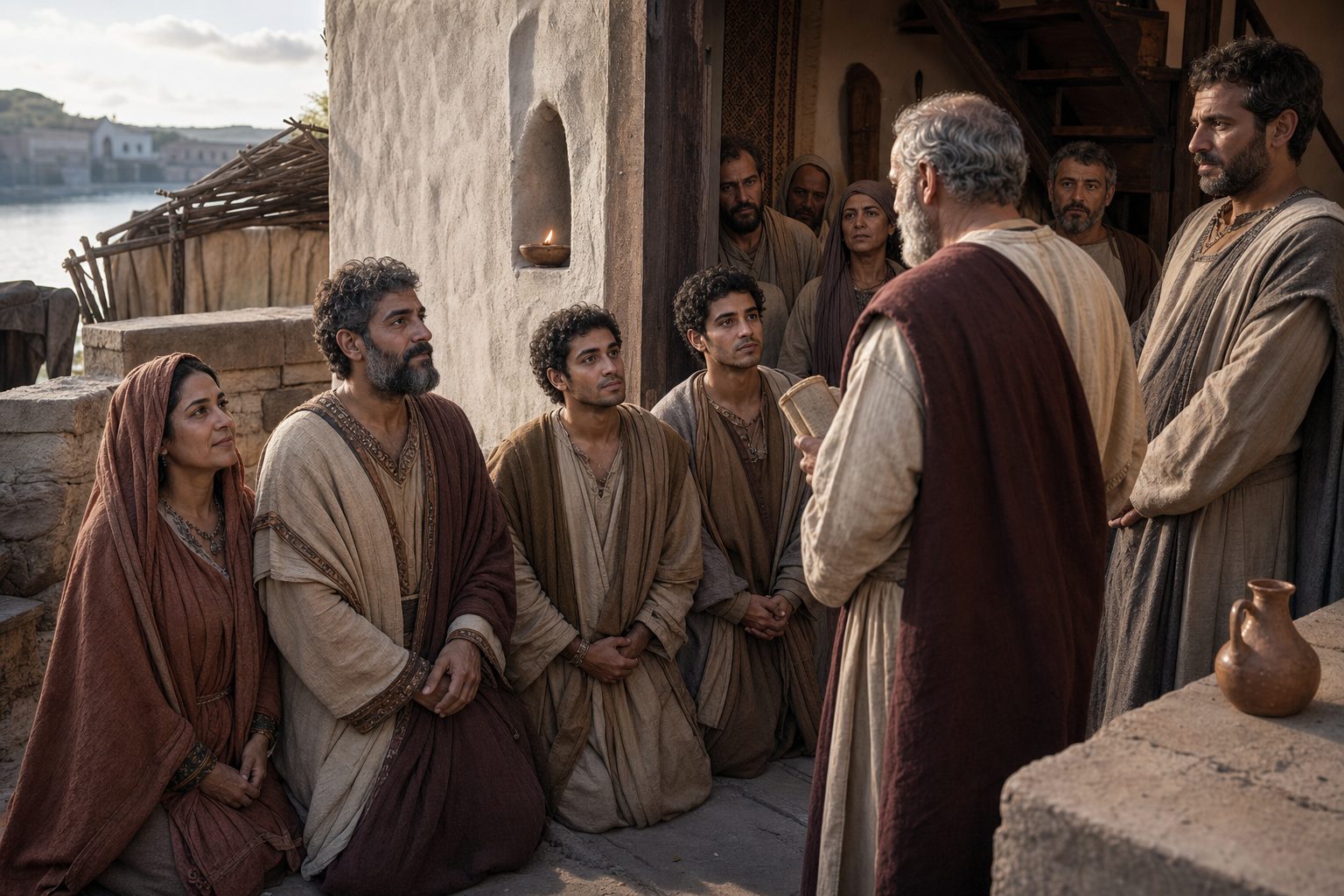
During the reign of the Roman Emperor Claudius [here understood to be Emperor Claudius II, who reigned in Rome from 268 to 284 C.E.], a man of noble birth, a rich Christian, named Marius, came from Persia to Rome with his wife, Martha, and his two sons, Eudiphax and Habakkuk, to pay homage to the tombs of the holy Apostles and other saints.
In Rome, they began visiting Christian prisoners and burying the bodies of those executed for their faith in Christ.
After crossing the Tiber [Tiber <unk> is one of the most important rivers in central Italy; not far from its banks is the ancient capital of the Roman Empire, the city of Rome.] , they found there in another city the holy martyr Cyril, who had been imprisoned and who had already suffered much for Christ.
When they arrived, they fell at Paul's feet and prayed for him. Then they put on the clothes and washed their feet. They stayed there eight days, because Claudius had ordered that those who belonged to the faith be put to death.
Shortly thereafter, 260 Christians who had been ordered by the emperor to dig the earth were captured and imprisoned outside the city, on a road called the Salarian Road, where pottery was made.
The emperor ordered the soldiers to shoot all these Christians with arrows in public places and burn their bodies.
When Mary and Martha and their sons learned of this, they were greatly saddened and, going with St. John the Presbyter to the place of execution of the holy martyrs, they secretly took the bodies of the holy martyrs, as many as they could take out of the fire, wrapped them in clean cloth, and buried them in a cave.
These were underground corridors, the walls of which were carved, where the bodies of the deceased were laid without a coffin and then covered with stones and marble slabs.
They also gathered here for worship and especially for the Eucharist, and the marble slabs over the coffins of the holy martyrs served as thrones.]
Along with the bodies of these holy martyrs, they buried the body of one of the imperial tribunes who had been killed for Christ [Tribunes were at first the chiefs of the tribes, or parts of the Roman population, and later came to be called by this name the persons of many public offices, chiefly the chiefs of military units, who represented something intermediate between our colonel and the company commander.
One of these men was a man named Blasto, who belonged to the Praetorian Guard. They stayed there for a long time with John the Baptist. They fasted and prayed. When Claudius heard about this, he sent for Mary and her companions, but they could not be found.
When they returned from that cave and came to the dungeon where the holy martyr Cyril was imprisoned, they did not find him there, for the night before their arrival he had been killed with a sword and thrown into the Tiber.
The Romans usually buried their dead in the walls along the underground corridors, but wealthy people, such as Pontian, sometimes arranged whole, often very extensive, rooms away from the passageways, where all the family members were buried.
When they crossed the Tiber, they heard the voices of Christians singing from the roof of a house in the still dark of the night.
And when they heard the voice of the singing of the Christians, they were exceedingly glad, and came and knocked at the doors of the house; but the Christians that were in the house would not open the doors to them, for they feared the Gentiles, lest they should attack them. Then the holy bishop Callistus said unto them that were with him, Take courage, fear not: Christ knocketh at our doors: we will open unto him, for he calleth us to this.
So he stayed in the house for two months, and they prayed there day and night.
At that time Claudius, the emperor, ordered that a man named Valentinus, a member of the high court, be brought before him and questioned.
Why, then, are you not like us? I have heard enough of your doctrine of Christ, and I am surprised that you, a man of learning, are led astray by empty talk.
"If you knew the gift of God that is in our faith", answered the blessed presbyter Valentine, "you would gladly accept our faith and yourself and your people, and turn away from false gods and man-made idols and confess to one almighty God the Father and his Son Jesus Christ, who made all things that exist, the heavens and the earth and the sea and all things that are in them.
Then one of the emperor's attendants, a law clerk, said to the holy presbyter: <unk> What do you think of the god Zeus [Dius or Zeus, or Jupiter, according to Greek mythology, was the son of the junior titan Saturn, who ruled first on the island of Crete and then took over the whole world, and his sister Rhea.
Saturn had several sons and daughters by Reia, but swallowed them immediately after birth, as his mother Gaia had predicted that he would be overthrown by his children.
Zeus was revered by the Greeks and Romans as the father of gods and men, the mighty and formidable ruler of heaven and the entire universe, the one who sent thunder and lightning to the earth, and the chief deity.
Greek myths attribute to him a carnal relationship with many secondary goddesses and even with human wives and assimilate to him, as to other gods and goddesses, various human passions and vices.] and Mercury [Mercury, otherwise Hermes, son of Jupiter and his sister Hera; revered by the Greeks and Romans as the messenger of the gods, the executor of the will of Zeus, the mediator between gods and men, the god of eloquence, as well as the god of various revelations,
the god of inventions and crafts, the god of industry and commerce, which supposedly only brings wealth when combined with cunning, deceit and even theft, <unk> hence Hermes was the patron of theft and deceit, who approved of all kinds of lying and oath breaking.] ?
"I can think of nothing else", said St. Valentine, "but that they were pitiful and ungodly men, who spent their lives in wickedness, vice, and pleasure. And if you tell me about their origin and their deeds, you yourself will see how wicked they were".
When Claudius heard this, he said to him, "If Christ is God, how can you tell me the truth about him?"
"O king, hear me! Your soul will be saved, your kingdom will be increased, and your enemies will be destroyed. You will conquer all, and you will enjoy a temporary kingdom here, and in the next life eternal.
But a man named Calpurnius, who was an administrator in the provinces, stood up and said to Paul, "You are being tempted by this man's empty teaching.
And when the bishop had said these words, the emperor's heart was changed, and he delivered to Calpurnius the holy presbyter Valentine, and said to him sorrowfully, Hear him patiently, and if the doctrine which he preacheth be found not to be sound, deal with him according to the law of the thieves of holy things; but if thou findest that his counsel is sound and true, why should we not hear him?
The bishop Calpurnius took St. Valentine and entrusted him to one of his former chief dignitaries, named Asterius, a man known for his wisdom, and said to him: "If you can persuade this man with words to agree with us, I will report your skill to the emperor, and you will be his friend.
After this, Asterius took the presbyter Valentinus to himself and brought him to his house.
<unk> God of all visible and invisible creatures, Creator of the human race, to deliver us from the delusion of the devil and to bring us out of darkness into the light, sent his Son, our Lord Jesus Christ, who has called us to himself, saying: "Come to me, all you who are weary and burdened, and I will give you rest" (Matt. 11:28), turn this house to yourself and give light beyond the darkness, so that it may know the Father <unk> God and in union with the Holy Spirit of Christ forever. Amen.
When the saint finished his prayer, Asterius, hearing his words, said to him: <unk> I am surprised that you call your Christ a light. <unk> Indeed, <unk> St. Valentine answered, <unk> Our Lord Jesus Christ, born of the Holy Spirit and the Virgin Mary, is the true light that enlightens every man who comes into the world (John 1:9).
"If he can make all men see", said the priest, "I will now test you. My daughter is two years old and blind. In the name of the Lord Jesus, if you will make her see, I will do whatever you tell me".
And he went in haste, and brought the blind girl. And St. Valentine lifted up his hands, and lifted up his eyes to heaven, and prayed long and with tears, and laid his hand upon the blind man's eyes, and said, Lord Jesus Christ, enlighten thy servant, for thou art the true light. And when he had said these things, the young girl immediately received her sight.
If you believe in Christ with all your heart, destroy all the idols in your house, fast, forgive all your debts, and be baptized, then you will be saved.
And they were glad to do all this, and St. Valentine made them fast three days, and taught them the truths of the holy faith, and because there were many prisoners under Asterius, he set them all free, and set them free out of the prison.
After three days of fasting, Sunday arrived, and Asterius was baptized with all his household, which consisted of 46 men and women, after which he invited his holy bishop Callistus to his house and received his blessing.
Meanwhile, when the emperor learned that Asterius had been converted to the faith of Christ by the teaching of the presbyter Valentinus and had received baptism with all his household, he immediately sent soldiers to arrest him and all his household, and the soldiers, coming unexpectedly, seized all those in Asterius' house, among whom was St. Marin with his wife and sons, and brought them to the emperor.
The latter ordered the presbyter Valentinus, his wife and sons to be separated from the others, while Asterius and his household were sent to a city called Ostia [the city of Ostia was located southwest of Rome at the mouth of the river Tiber, on the coast of the Tyrrhenian Sea.
And they brought them to Ostia, and delivered them into the hand of a judge, named Gelasius, who, when he had seen them, commanded them to be cast into prison. And when twenty days had passed, he commanded them to be brought before the judgment-seat, and said unto them, Know ye what the emperor and all his counsellors have commanded?
"We do not know", they replied. "The judge said, "It is decreed that those who worship the gods should live and be free, and those who do not worship them should be put to death after various torments".
When the judge heard this, he was furious, and immediately ordered that St. Asterius be hanged and tortured, and that all the others be beaten with rods without mercy.
And it came to pass on the morrow, when the people were come together, that Gelasius came into the theatre, and sat in the judgment-seat, and commanded that St. Asterius and the other martyrs should be brought before him, and said unto him, Cease thy madness, and offer sacrifice unto the gods, lest thou perish in this affliction, thou and all that are with thee.
"We all wish to die for Christ", answered St. Asterius, "as He died for us sinners, to cleanse us from the filth of this world, to be worthy of entering into the desired kingdom of heaven".
And it came to pass, when they were come into the pit, that the partition was opened, and the last of the beasts were let down upon them; and the holy martyrs were taken away, and cast into the pit, and they were cast into the pit.
O Lord God Almighty, who delivered thy servant Daniel out of the den of lions, and through the prophet Habakkuk who visited and strengthened him [The story of Daniel's six-day stay in the den of lions is in chapter 14 of the book of the prophet verses 28-42, and his visitation by the prophet Habakkuk is told in the life of the last, placed under the second day of the month of December.] , You and us, your servants, visit through your holy Angel.
And when the beasts came out of the wall, they did no harm to any of the holy martyrs, but they worshipped the holy Astarte and those who were with him. And when Gelasius saw it, he spoke to the people, saying, See how these men have tamed the beasts with their sorceries. And many of the people said, Let the god whom they serve save them.
And when the great fire was kindled, St. Asterius said to the other holy martyrs, Be strong, fear not; for he that was seen in the furnace of Babylon with the three young men is now standing among us.
And when the holy martyrs were cast into the fire, the flame died immediately, and the heat was turned into coldness, and the saints were not hurt.
But when the holy martyrs, Marinus, Martius, Audifax, and Habakkuk, were left in Rome with the blessed presbyter Valentine, Claudius the emperor ordered them to be brought before him for judgment. First he ordered that St. Valentine be beaten with sticks and then be beheaded with a sword, and then he turned to St. Marinus and those who were with him and said to them, "Where are you from?" The saints answered.
And he said unto them, Wherefore then have ye left your country, and come hither? And they said, We have desired to worship before the sepulchres of the apostles, and to pray unto our Lord. And he said, Where is the silver and the gold that ye have, for I hear of you that ye are rich? And they said, We have purchased them of our substance, which we had in Persia in abundance, and which we sold.
And part of the proceeds of the sale we have given to the poor, and part we have brought with us, and not for ourselves, but for the service of the saints. And how rich we were in Persia, thou canst perceive from what noble line we are. My father Marmelay was first after the king of Persia, and this, my wife, is the daughter of Cusinith, the great prince of Persia.
And he said unto them, Why then have ye forsaken your gods, which are worshipped in Persia, and come hither to seek the dead? And they said to them, We are the servants of Christ; and we have come to worship the holy apostles, whose souls are immortal with God, that they may intercede for us before Christ our God. And Claudius said unto them, Where then is the silver and the gold that ye brought from Persia?
"We have given him to God", said St. Marin, "who has given him to us for the time being". The emperor was enraged at these words and gave the holy martyrs to his governor, named Muscianus, and said to him: "If they do not sacrifice to the gods, after various torments let them die".
Muscian, taking the saints, sat on the judgment seat in the temple of the Roman goddess Telluda [Telluda or Telluus <unk> the ancient Italian mother goddess of the earth, invoked in prayers together with Ceres. As the representative of the earth, Telluus was opposed to Jupiter, the goddess of the sky.
In addition, Telluda was considered to be the creator of world order, the giver of prosperity and the protector of marriages like the Greek Demeter.
Sempronius vowed to erect a temple in honor of Tellus, which was built on the western slope of the Esquiline mountain, but the temple in honor of the Eleusinian triad, Demeter (Tellus), Dionysus and Cora, was arranged in Rome in 486 BC on the Greek model and by Greek artists.] and, having condemned them to torture, he ordered to lay down all the instruments of torture before them and began to threaten them with cruel tortures, trying to force them to sacrifice to idols.
But the saints did not submit to his will, and he began to torture them. First he ordered that St. Marin should be thrown to the ground and be beaten with sticks for a long time. While being beaten, the holy martyr uttered only the following words: "Praise be to you, Lord Jesus Christ". Then they also began to beat with sticks Eudiphaxes and Habakkuk.
At this time, the mother, St. Martha, seeing the suffering of her children, encouraged them with motherly exhortations to bear with courage the sufferings of Christ, who suffered so much for us. After this, the martyr ordered to hang these three martyrs, father and sons, on a torture instrument and to cut off their bodies with iron nails and burn their ribs with fire.
"We thank thee, O Christ our God, that thou hast made us worthy to suffer these things for thy name's sake". Then Muscian ordered the saints to be taken from the instruments of torture and their hands cut off, and Martha took their blood and joyfully anointed herself with it, and then hanged their cut hands on their necks and led them through the whole city of Rome.
To this the saints cried out, "They are not gods, but demons, who will destroy you and your king". After such sufferings the holy martyrs were led thirteen furlongs from the city to a place called Nympha Catavassi; and the heads of St. Maryna with Odifax and Habakkuk were cut off, and St. Martha was drowned in the river.
Their relics are now in the church of St. John the Baptist in Rome, and the relics of St. Valentine <unk> in the church of Praxedes.]. A Christian woman named Felix secretly took the bodies of the decapitated holy martyrs, and also found in water the body of St. Martha, and buried them in her field, glorifying our Lord Jesus Christ, with the Father and the Holy Spirit, glorified forever and ever. Amen.
On this same day, the memory of the martyrs Isaurus the deacon, Innocentius, Felix, Jeremiah, Vasily and Peregrine, who were from the city of Athens and suffered for the name of Christ at the hands of the military commander Tripontus in the Macedonian city of Apollonia, under the emperor Numerian (283-284), were cut with them and two city chiefs Rufus and Rufus.