The transfer of the relics of our reverend father Theodosius, the abbot of the Cave
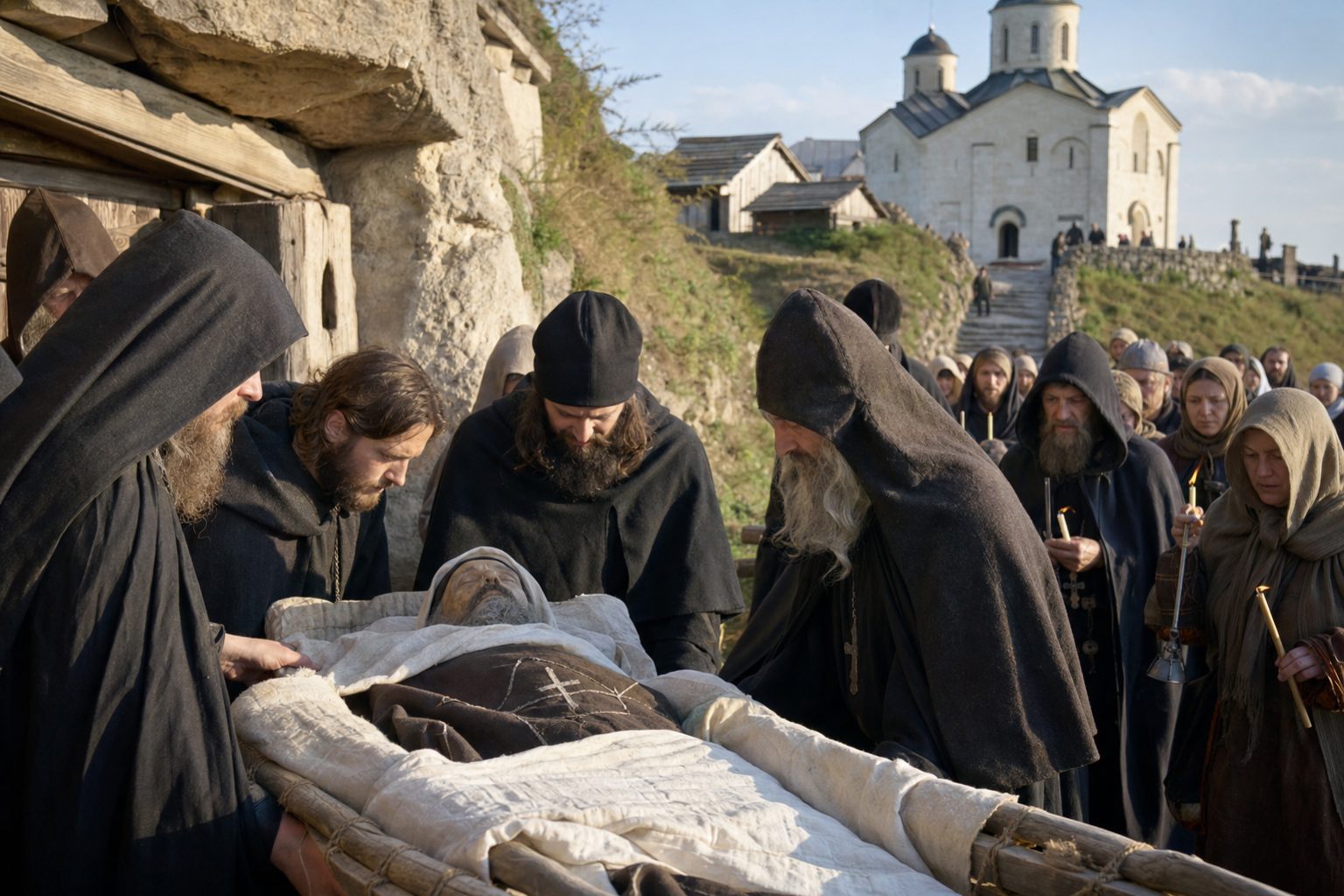
In the eighteenth year since the soul of our reverend Father Feodosius was translated from earth to heaven, the Lord willed that his body also be translated from the cave to a holy and heaven-like cave church.
All the brethren of the holy, great and miraculous cave laurel, having gathered together with their leader, their abbot John, came to the unanimous decision, after a council, to transfer from the cave to the great stone church the honourable relics of the blessed and godly Theodosius, a man of holy and high life, marvellous in virtues and glorious wonders. The brethren spoke among themselves:
Why are we in vain without our father and teacher? It is not fitting for us to be without a shepherd, nor is it fitting for a shepherd to leave the sheep entrusted to him by God, lest a wild beast should rob the worded flock of Christ.
Then all said in unison: "Let us take the honourable relics of our beloved father and carry them out of the cave here: 'When you light a lamp, says the Lord, you put it, not under a container, but on a lampstand, and it gives light to all in the house.'" - Matt. 5:15.
And when the day of the Assumption of the Blessed Mother of God was at hand, three days before the feast, the abbot ordered to go to the cave and dig up the place where the relics of our reverend father Theodosius were laid.
And I will tell you the truth and the truth, for I did not hear it from others, but I myself was the first to take part. And when Iugumenus came to me, he said, "Let us go, my son, to our most excellent father Theodosius".
And the abbot said unto me, Take with thee whomsoever thou wilt of the brethren, and speak not unto any man, save these chosen ones; and let no man of the brethren know until we have brought forth the honourable corpses to the place before the cave.
And when they came to the cave, and prayed, and sang psalms, and went about, and did not delay; and I began to dig, and after much labour I gave the charge to another brother; and we dug until midnight, and could not find the remains of the saint; and we wept and wept, and thought that the saint would not be pleased to appear to us; but this thought was changed, and said, Shall we not dig in another direction?
So I took my weapon again and started digging even harder, and one of the brothers who had been with me and who was in front of the cave, hearing the beat of the church bell, told me that the church bell had already been struck.
And I said unto my brother, I have digged, and when I did, I was afraid, and cried out, For the sake of St. Theodosius, have mercy on me, O Lord.
And when I had dug deeper, I beheld the relics lying in a holy place, and all their parts were whole, and no corruption had touched them; their faces were bright, their eyes closed, their mouths joined, and their hair was dry to the head.
That night, two brothers were watching in the cave monastery as the abbot secretly carried the relics of the monk with an unknown brother, and they watched intently in the direction of the cave; when they struck the church bell in the morning, they noticed that three pillars, in the form of light-bearing arcs, had moved over the cave of the monk Theodosius to the top of the great church where the monk was to be carried.
This was seen by other monks who were going to church in the morning, and by many of the pious citizens of the city. The worthy Stephen, who was after St. Theodosius the abbot of the cave, and afterwards founded a monastery at Clove, and afterwards, by the will of God, became bishop of the city of Vladimir, was then at Clove in his monastery; and that night he saw a great dawn over the cave through the field.
And when they came to the cave, they saw many candles, but when they came to the cave they saw nothing.
Then they realized that the divine light they had seen had come from the honest relics of St. Theodosius. When they reached the cave's doors, Stephen and Clement saw St. Néstor and the brothers surrounding the honest relics.
The next day, after obtaining the relics of the reverend, by the will of God, the god-loving bishops gathered: Ephrem Pereyaslavsky, Stefan Vladimirsky, John of Chernygov, Marin Yuryovsky, Antony of Poroshenko, <unk> gathered and the abbots of all the monasteries (Kiev) with many blackheads; a lot of devout people came from the city, who came from the city with candles and incense.
And they took the holy relics of St. Theodosius, and carried them into the church of the Most Holy One. And the most holy church rejoiced when they received their lamp, so that the light of the day was covered with the light of a candle.
And so they laid the relics in the church of the Assumption of the Most Holy Mother of God, founded by St. Theodosius, on the right hand side, on the fourteenth day of the month of August, on Thursday, at one o'clock in the afternoon, and solemnly celebrated this day.
In the days of the abbot, the only concern of St. Theodosius was to manage the flock as best he could; he took care not only of the blackheads, but also of the salvation of worldly people, especially of the children of his clergy; he comforted and instructed those who came to him; he sometimes visited their homes and gave them blessings.
Among the nobles there was a spiritual son of St. Theodosius, named John; his wife Mary and he were pious men, leading a chaste life. The Blessed Father, coming to their house one day, he loved them, because they lived according to the commandments of the Lord and in love with each other. He began to teach the couple about charity to the poor, about the kingdom of heaven, prepared for the righteous, and about the punishment of sinners, and many other things from the divine scriptures, until the word came to them.
to the position of the body in the coffin.
The prophetic gift was being fulfilled, and the prophetess said to him: "Truly I say to you, Where my body will be laid, there you too will lie down after a few years".
It was in the eighteenth year of his canonization that his relics were transferred, and it was at this time that the wife of John, Mary, was transferred.
Then, in the fifteenth year after the transfer of the relics of the monk Theodosius, the husband of Mary, the great boyar John, a masked ninety-year-old man, son of the brave voivode Vyshata, grandson of the voivode Ostromyr and himself a long-time former voivode, appeared; John was righteous and not worse than his ancestors, as a kind, meek, humble man, far from evil.
He was laid at the head of his wife against the tomb of the same saint Theodosius, so that on him too the prophecy of the blessed father about the position where his body lies was fulfilled.
The Lord, who glorifies those who glorify Him, and has favored the transfer of the relics of St. Theodosius from the dark cave to the holy cave church in the eighteenth year after His presentation, desiring to glorify even more His pleasing, has favored the transfer of his name and veneration from the dark ignorance to all the Orthodox churches, also in the eighteenth year after the transfer from the cave, <unk> let this lamp shine to the whole world.
The Cardinal entrusted to the heart of Blessed Feoctist, the Cave Iggumen, the task of seeing to it that the name of St. Theodosius was inscribed in the synodic or church collection, and that he was counted among the ancient holy fathers and all the saints, whose feast the Orthodox Church celebrates everywhere.
The Blessed Feoctist began to remind this to the great prince Mikhail-Svyatopolk Izyaslavich [Great Prince of Kiev 1093-1114]. He asked him to order the most exalted metropolitan Nicéphore [Nicéphore <unk> the first metropolitan of this name 1103-1121] to gather a consecrated council of bishops, abbots and all the church clergy and tell them the reason for the meeting, and then let everything be done as God wills.
The metropolitan listened to the prince with pleasure, gathered the bishops, the clergy and the entire church clergy and informed them about the supposed celebration of the reverend Feodosia.
The bishop ordered the bishops to inscribe the name of St. Theodosius in all the churches of his diocese, and the bishops gladly did so: they inscribed the name of St. Theodosius and began to commemorate him in all the temples, praying to him and celebrating his feast day with praise every year in honor of the God who gives everything and pleases Him, the gifted Theodosius.
Blessed Feoctystus, who was eager to serve his father, the monk Theodosius, and write his name in the collection, was rewarded by the Lord: after a short time, he was elected bishop of the god-saving city of Chernihiv and was ordained by the same pre-eminent metropolitan Nicéphore.
When he ascended to his throne, the Christ-loving Prince David, the princess, the boyars and all the people received him with inexpressible joy, as having created inexpressible joy for the church by inscribing in the collection of the name of St. Theodosius.
From here he was taken by the great prince Vsevolod Yuryevich to be the abbot of the Christmas monastery he founded in Vladimir; then Simon was appointed the first bishop of the diocese of Vladimir, which was separated from Rostov in 1214.
From the epistles of Bishop Simon of Vladimir to Polycarp, also a barber and later a monk of the cave monastery, and from the epistles of Polycarp to Aquincum, the archimandrite of the cave, which contain a number of tales about the cave miracle workers and about the miracles of those who were in the monastery itself during the construction of its great church, and composed the famous Cave Paterick.] about the miraculous decoration of the honorable skull of our revered father Theodosius with gold and silver,
who, with his honest relics, decorated the holy cave church with gold and silver, and the other Orthodox churches with the honor of his noble name.
After a long time of transporting the relics of St. Theodosius, the son of Simon and grandson of African, the Varangian princes, the commander-in-chief Georgy, who ruled the region in Suzdal from Prince Georgy Vladimirovich Monomakhovich, wanted to decorate St. Theodosius' honorary cross as a sign of his great love for him.
He sent from Suzdal to Kiev, to the Cave Monastery, one of his boyars, named Vasily, and handed him, to bind the monk's cancer, five hundred hryvnias of silver and fifty hryvnias of gold. Taking the silver and gold, Vasily reluctantly set out, cursing his life and the day of his birth:
And he said in his heart, What is this that my lord desireth to destroy, and what is the reward that he desireth to lay up for himself? Behold, he hath laid it up in vain, and in vain; and woe to me, for I was not able to rebel against my lord! Why then have I forsaken my house, and for whose sake have I gone this bitter way? and from whom shall I be honoured? for I am not sent to a prince, nor to a great man; and what shall I say to a handful of stones?
And who will answer me? Who will not laugh at my madness? And so many other things did Basil say to those who accompanied him. And St. Theodosius appeared to him in a dream, saying meekly: "O my son, I wanted to reward you for your labor, but if you do not repent, you will suffer many troubles". But Basil did not stop complaining, and the Lord brought great plague upon him for his sins: all the horses died, and the property, except the treasure sent, was stolen by thieves.
Then Vasiliy took a fifth of the treasure, consisting of gold and silver, sent to bind the holy river; he spent it on his needs and the horses, not realizing, at the same time, about the punishment that befell him for blasphemy.
And that night St. Theodosius came to Basil and said: "Bassilus, have you not heard the words of the Lord: 'Make friends for yourselves by means of the unrighteous riches, so that when they fail, they may receive you into the eternal dwelling places' (Luke 16:9); and, 'he who receives a righteous person in the name of a righteous person will receive a righteous person's reward' (Matthew 10:41).
My son, George, has done a good thing, and with him, and with you, for your labor, you were to be crowned, and not everyone will have the glory that you had to be an accomplice with George. Now you have lost everything, but still do not despair in your life, although you can heal in no other way than by repenting of your sins.
Have yourself taken to the cave monastery, to the church of the Most Holy Mother of God, and let them put you on my bed and you will be well; and the gold and silver you have spent will be found in the whole.
The next morning Prince George Vladimirovich came to see Vasily with all the boyars, and when he saw him in a great illness, he went away sad. Vasily, believing in the vision of the saint, ordered to conduct himself in the cave monastery.
"Go quickly to the shore, fetch Basil, and lay him in the tomb of St. Theodosius; and when he gives you the treasure, declare to him before all that he has taken a fifth of it, and if he repents, forgive him". With these words the speaker disappeared.
And he went to the Dnieper, and brought Basil, and laid him on the rock of St. Theodosius; and Basil rose up and was well; and he gave him the treasure that was entrusted to him, and said, Behold, thou shalt find here four hundred shekels of silver and forty shekels of gold. And he said to him, Chado, and where are another hundred shekels of silver and ten shekels of gold? And Basil began to repent, and confess, I have taken and spent; be patient, my father, and I will restore it all to thee; for I thought I would hide it from God, the all-seeing.
And they took out the gold and the silver out of the vessel, where it was under the seal, and weighed it before them all, and found in all five hundred pieces of silver, and fifty pieces of gold; and they all praised God and St. Theodosius.
In the morning the prince, taking with him the doctors, came to the place where he saw the sick Vasily, wishing to cure him, and did not find him. Hearing that Vasily had been taken to the cave monastery and thinking that he was already dead, the prince hurried to the monastery and found Vasily there, as if he were not ill.
On hearing this, Georgy Simonovich, the commander of the legion, became even more enamored of the Blessed Mother of God and of St. Theodosius; he added to his great gift a ring [i.e., a chain that was worn as an ornament on his neck] which he himself wore and which contained a hundred gold rings; he wrote the following:
Behold, I, George, son of Simon, servant of the most holy Mother of God and of the holy Theodosius, blessed by her holy hand, was a blind man for three years, and saw not the light of the sun, but by the word of the saint I was healed, for I heard from his mouth, "See!" and saw.
Let no one separate himself from the monastery of the Most Holy Mother of God and the venerable fathers, Antony and Feodosia of the Caves; their prayer brings intercession in the villages of the monastery: when we and the Polovtsians [Polovtsi or kumans <unk> a Turkic nomadic tribe who lived in the X-XIII century in the south of Russia and from here made raids on the border cities and villages of the Russian land] came to Izyaslav Mstislavovich, we saw a high city from afar, and immediately
We've moved away from him.
And we came to know that it was a cave-dwelling-village, and that there had never been a city there; and the inhabitants of the city knew not what had happened; and they went out in the morning, and behold, it was a bloodshed, and they were very much astonished.
Wherefore I write unto you, that all of you are inscribed in the prayer of St. Theodosius, who promised my father Simon to pray for us, as he prayed for his black-haired ones; and he wrote the prayer which my father commanded, when he was laid in the coffin, to lay in his hand, in expectation of the fulfillment of the promise, of which, appearing to one of the godly fathers, he said thus:
Tell my son, George, that I have received the blessings of the prayers of the saint, and you, my son, follow me in good works. Whoever does not desire the blessings and prayers of St. Theodosius and turns away from him, let him love the oath, and let it come upon him.
This is the end of the epistle of the above-mentioned Georgius the Christ-loving; and we, who are concluding the present tale, should learn from him, <unk> let us not evade the blessing and the many-hurried prayer of our revered father Theodosius, but let us draw near to him by good works, and he will draw near to us.
so that you may be blessed with an inheritance in the kingdom prepared for you from the beginning of time through our Lord Jesus Christ, to whom be glory, power, honor, and worship now and forever and ever. Amen.