The life of our holy father Ephraim, Patriarch of Antioch
St. Ephrem was initially a military commander in the East during the reigns of Emperors Anastasius [Anastasius I reigned from 491 to 518] and Justinian [Justin I reigned from 518 to 527].
His election to the patriarchate was by the grace of God and the revelation of the same holy bishop who lived at a time when the city of Antioch was being rebuilt after the destruction.
At that time, due to the proliferation of various heresies and heretics in Antioch, the Nestorians [Nestorianism was founded by Nestorius, bishop of Constantinople (bishop from 428 to 431) ] taught that Jesus Christ is not the true God, but only a man, the son of Joseph and Mary, honored for the holiness of life by the special grace of God and saving us not by His redemptive merits, but only by the teaching and example of His life.
Nestorianism was condemned at the Third Ecumenical Council held in Ephesus (in 431).
Euthychianism was founded by Constantinople archimandrite Euthychius, who taught that Jesus Christ had only one nature - divine, whereas the Orthodox Church has always recognized and recognizes in Jesus Christ two natures, unfused and indivisible: divine and human, the euthychians were called also - monophysites (or "one-nature", - from Greek monos - one and pyos - nature).
This heresy was condemned at the Fourth Ecumenical Council held in Chalcedon in 451, but which also existed in the time of St. Ephraim (IV century), and even much later.] and others, blasphemies were pronounced against the deity of Christ and the honor of the Holy Mother of God was humiliated; therefore, the wrath of God broke out over the city of Antioch.
On the twenty-ninth day of the month of May, Friday, at noon, there began a terrible earthquake; with it a fire engulfed the whole city. The earthquake destroyed the stone buildings and the city walls; and the fire destroyed all the rest; this was to show to all the great wrath of God for the sins of man.
Antioch almost became like Sodom and Gomorrah [Sodom and Gomorrah - Palestinian cities in the Jordan Valley that were notorious for their wickedness, for which they were destroyed by God.
Gen.19:1-28). For most of the city was destroyed, and with it a multitude of citizens, some of whom died under the collapsed buildings, others were burned by fire; among others died under the collapsed column the Patriarch of Antioch Euphrasius.
The rest of the people wept and wept bitterly, and all the surrounding towns and countryside were terrified.
This divine wrath, which was raging against Antioch, was seen with spiritual eyes by some of the holy fathers who were far away from the city (as, for example, St. Theodosius the Great [His memory is celebrated on the 11th day of January], formerly in Palestine, St. Zosima [See his life below under the same number], formerly in Caesarea of Palestine).
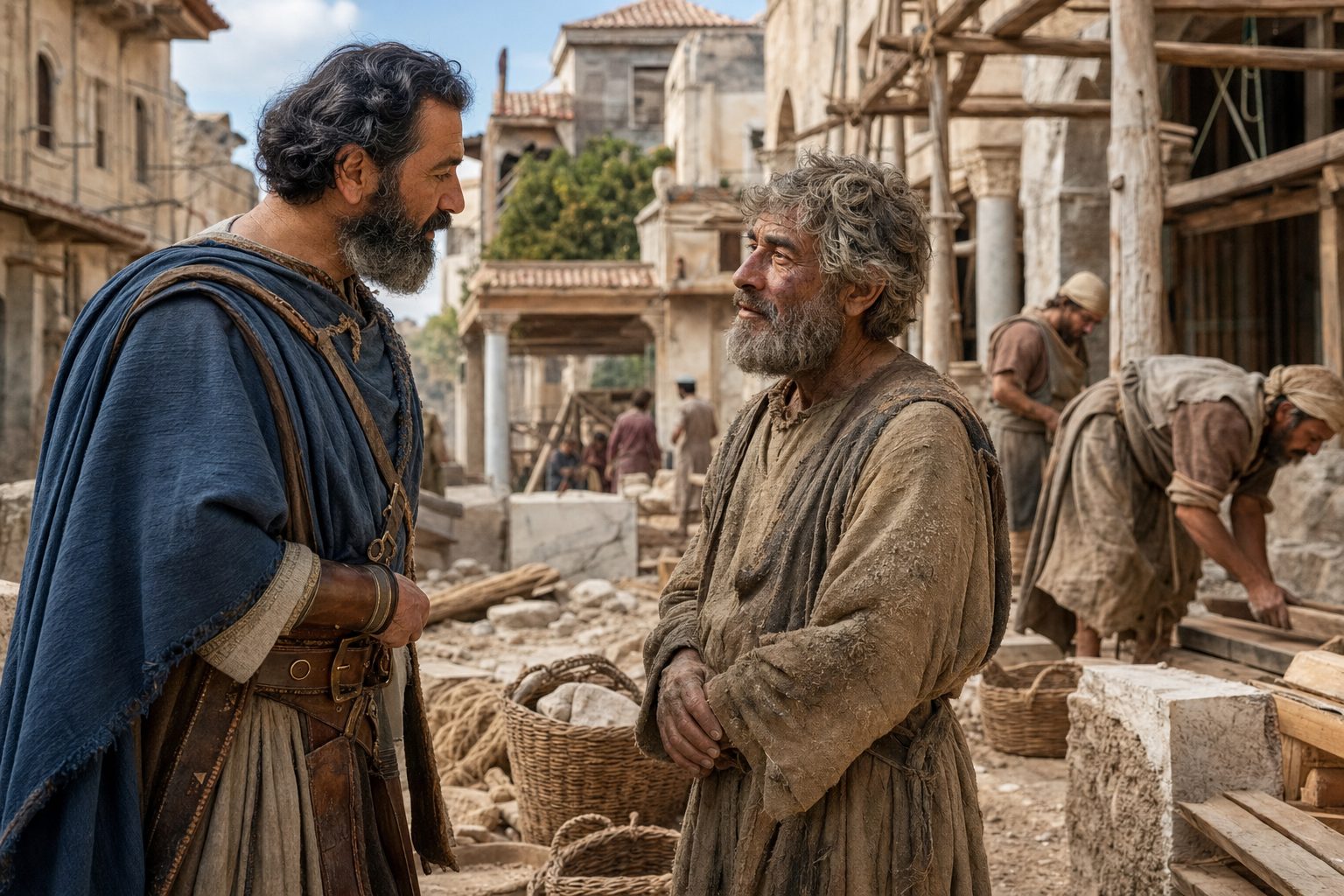
And when they had come to Antioch after the great earthquake and the great fire, Ephraim the blessed, the commander of the east, was sent by the emperor to rebuild the city, and Ephraim diligently did it.
Among those who worked there was a bishop, then unknown to anyone, who, having stripped himself of his episcopal rank and title, built the building with other workers under the guise of a beggar.
And Ephraim the captain of the host saw a vision, and he lay down, and fell asleep; and behold, a pillar of fire reached unto the heavens over him; and Ephraim saw it, and was greatly afraid, for it was a dreadful thing.
And the prince knew not that the man was a bishop, for his appearance was unrecognizable; for he had the appearance of a poor man, and his head was always in dust, and his garments were torn, and his body was fatigued from his hard work, and his restraint. And he called the man to him, and asked him privately who he was, and whence he was, and what his name was.
I am one of the poorest men in the city, and I have no food to eat, and my wages are God's, and God has sustained me. Then God came upon Ephraim and said to him, "I will not let you go until you tell me the whole truth". And the bishop said to the captain of the army, "I want you to swear to me by God that you will not tell anyone about me while I live".
And Ephraim took an oath, and said, I have left the bishop's office for God's sake, and have come to a people unknown; and I work here, and my wages are meager; but my name and the city where I was bishop, I will not tell thee.
In these days the Lord will raise you to the episcopal throne of this Church of Antioch <unk> "to shepherd the Church of the Lord and of God, which he purchased with his own blood" (Acts 20:28), - our true God. So, as I told you, distribute abundant alms and, opposing heretics, stand firm for the Orthodox faith.
Meanwhile, the blessed Ephraim heard this and was very surprised, and he said to himself: "How many secret servants does God have that only he knows?"
But the bishop no longer dwelt among the workers, but withdrew to another place, not wanting to be recognized by men, for he avoided vain human glory. His prophecy was soon fulfilled, for after a few days, blessed Ephraim was appointed by God's destiny patriarch of the great city of Antioch.
One day he was told of a certain columnist who lived near Hierapolis [Herapolis was in the province of Phrygia in Asia Minor] - and it was Ephraim who was told that the columnist was in communion with the heretics the Severans [Severians - heretics who adopted the Monophysite heresy in a modified form].
The Severans, though they acknowledged, like the heretics the Monophysites, only one nature in Jesus Christ - the divine, but allowed in it the distinction of divine and human properties; thus they claimed that the flesh of Christ before his resurrection was, like ours, corruptible.
The great archbishop of God then personally went to him and begged him, and even tearfully begged him, to back away from Sever's error and join the communion with the holy Apostolic Church.
"How do you wish to see proof that by the grace of our Lord Jesus Christ, the Apostolic Church is free from the error of unbelievers?" the patriarch asked. "Let us kindle a great fire and let us both go into it; the faith of the one who comes out of the fire whole and unharmed will be true; we will follow him".
But if you want to experience things that are beyond my power, I trust in the mercy of the Almighty Son of God, who will do this to save your soul. " Then the patriarch said to those present, "Blessed be the Lord! Bring the wood here".
And when the wood was brought in abundance, the patriarch commanded a great fire to be kindled round about the pillar, and said unto the pillar, Come down from the pillar, and, according to thy word, let us both go into the fire.
"Have you decided to put God to the test by this? Why not go into the fire?" Then the patriarch took off his armor and stood near the fire. He looked up to heaven and prayed,
After completing the prayer, the patriarch threw his omophore into the middle of the fire, and despite the fact that the fire burned for about three hours and the wood was completely burned, the patriarch took his omophore out of the fire intact and not at all damaged.
"Wonderful at all that had happened, the columnist realized that the true faith is the faith of the patriarch; therefore he renounced his wickedness, cursing the North, turned to the holy council of the Apostolic Church and from the hands of the most holy patriarch Ephraim received the holy communion of the divine Mysteries of the Body and Blood of Christ and glorified God.
After a worthy management of the flock, he turned to God [The end of St. Ephraim followed in 545. St. Simeon the Wonderworker was notified of his death from above; at the moment of his death he saw his soul being carried up by angels to God (more about this can be read in the life of St. Simeon the Wonderworker, - under the 2nd of May).
Patriarch Photius (ruled the Constantinople church from 857 to 867; then secondarily from 877 to 886) testifies that although he was Syrian by origin and language, he was also proficient in Greek.
Almost all the writings of St. Ephraim were written in defense of the Orthodox doctrine of the Face of Jesus Christ and the union in Him of the two natures, divine and human, against the monophysites.] , to whom he served faithfully and truthfully all the days of his temporal life.
I 'm going to have to get back to you .