The Passion of St. Isidore
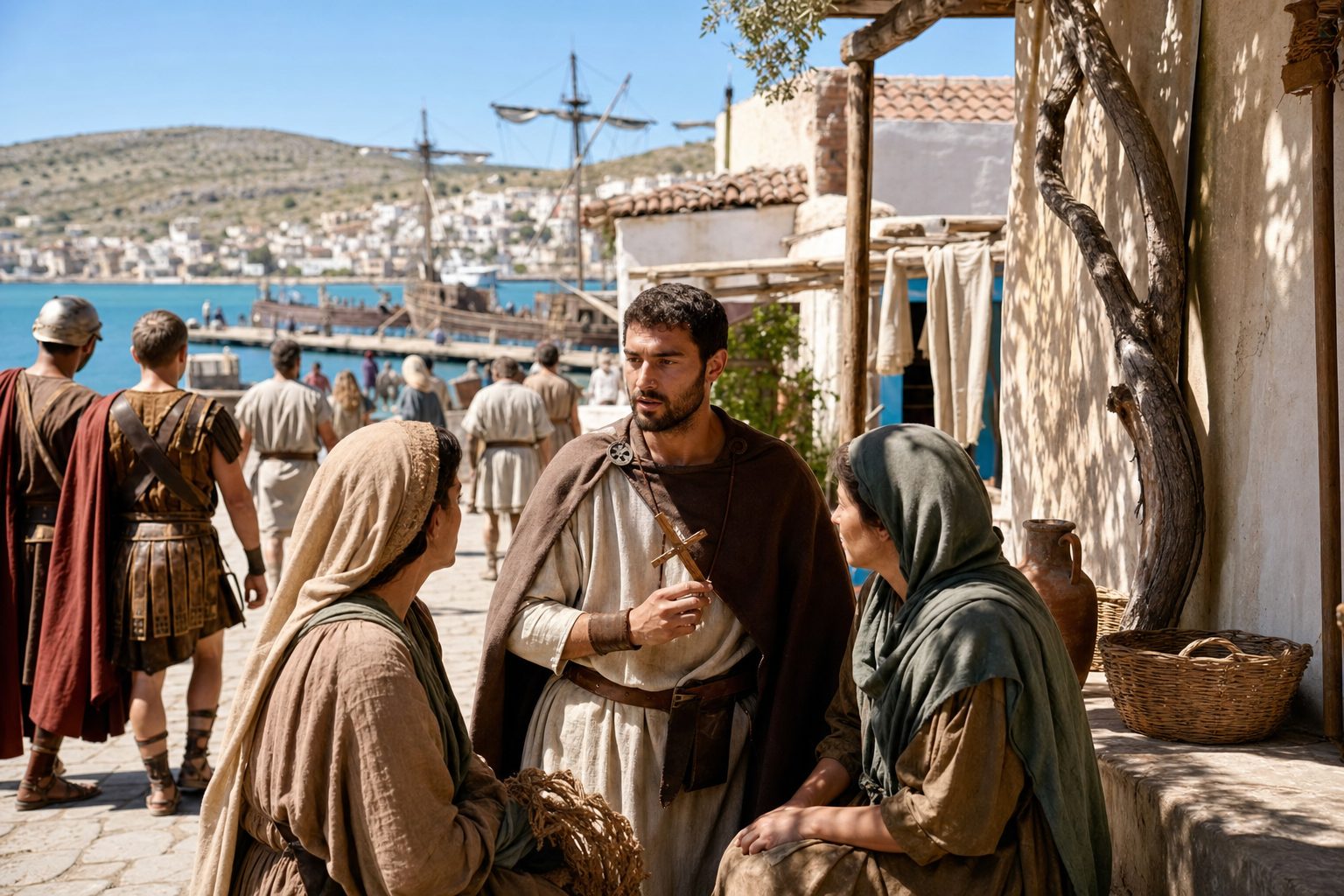
In the first year of the reign of Emperor Decius, a royal decree was issued in all the provinces and countries of the Roman Empire, ordering the recall of the soldiers and their regimentation. On this occasion, the ships of the Voivodeship of Numeria approached the island of Chios in order to gather all the young men destined for military service.
At that time there lived on the island of Chios St. Isidore of Alexandria, a strong man of body and spirit, and a Christian by faith. He lived a godly life, always diligently fasting and doing good works; he was alien to vain deeds and unclean pleasures of this world; in the same way he avoided unclean deeds of the Elenians. This Isidore for his bravery and courage was enrolled in the ranks of the soldiers and attached to the regiment of Numeriyev.
Soon a new order was issued from the emperor to force all Christians to worship the Roman gods; those who did not were to be tortured: soldiers were especially ordered to be watched; if a Christian was among them, he was to be forced to worship and sacrifice to idols, according to the ancient Roman custom.
But a centurion named Julius came to the governor of Numeria and told him that the blessed Isidore had become a Christian. The governor immediately ordered that the saint be taken.
"Who are your gods that I, a Christian, should sacrifice to them? Are they not deaf, blind, and dumb?" The governor said to this, "You wicked and wicked blasphemer! You are worthy of great punishment and punishment".
But I believe and hope that all who believe in Him and trust in His holy name will never die, as our Lord Jesus Christ Himself said: "He who believes in Me, though he die, yet shall he live".
If you kill me, you have no power over my soul. So torment me as you will, for I have as my helper the true and living God and the Lord Jesus Christ, who is with me now and in my death and will be with him.
But the saint said, "Don't think you're trying to trick me with your trickery, you wicked man. Can one who once denied Christ and his God be called a faithful servant?
And I will give thee counsel for thine own good, and hearken unto me; for if thou wilt not hearken unto me, I will deliver thee into the hand of the fierce torments, and will torment thee until thou confess the greatness of our gods.
"Obey, Isidore, the will of the emperor, if you do not wish to end your life in torment". But the saint answered, "I obey the will and command of my God, the King of heaven, who dwells forever.
After the beating, the torturer tempted the saint to idolatry and charm and threats for a long time, but he was completely unsuccessful and only heard the martyr's insults and reproaches both on himself and on his gods. Finally, filled with anger, he said, "I will order your filthy tongue to be cut in pieces". The saint replied, "Even if you cut my tongue, you will not take away the confession of the name of Christ from my lips".
And when he was lifted up from the ground, he could not speak a word, but waved his hand; and he asked for a piece of paper, and wrote thereon, saying, I command to cut off with the sword Isidore, who will not obey the king's commandment.
And when he had read them, he said, I thank thee, Lord Jesus Christ, that thou hast not forsaken me. I praise thee, Lord, my life, my breath. I praise thee, Lord, my strength, the enlightenment of my mind. I praise thee, who hast given me a tongue, wherewith I praise thy greatness continually.
And the executioner took the martyr, and brought him to the place of his execution, and St. Isidore went with joy and haste, hurrying like a lamb to his slaughter, and looking up to heaven with bright face and joyful eyes, said, "Holy Lord, I praise you that you have now, by your mercy, received me into your city and into your resting place.
And when he was come to the place where the head of the martyr was to be cut off, he asked the executioner for permission to pray, and after he had prayed long enough, he bowed his fair head under the sword, and was thus beheaded for confessing the name of Jesus Christ, the Son of God, who bowed his fair head on the cross for us sinners.
But one of the friends of the saint, named Ammonius, a secret Christian, took the body of the holy martyr, dug a tomb with the other faithful brethren, and laid the honourable body of Isidore in the earth as a precious treasure.
The honourable relics of St. Isidore were afterwards taken from the earth by a pious woman named Miropius, who came from Ephesus, anointed the honourable relics with precious ointments and covered them with a clean robe, and placed them in a place of honour.
The church, in which many kinds of healing were given to the sick by the holy powers of Christ's martyrdom, to the glory of Christ our God, glorified forever with the Father, and the Son, and the Holy Spirit. Amen.